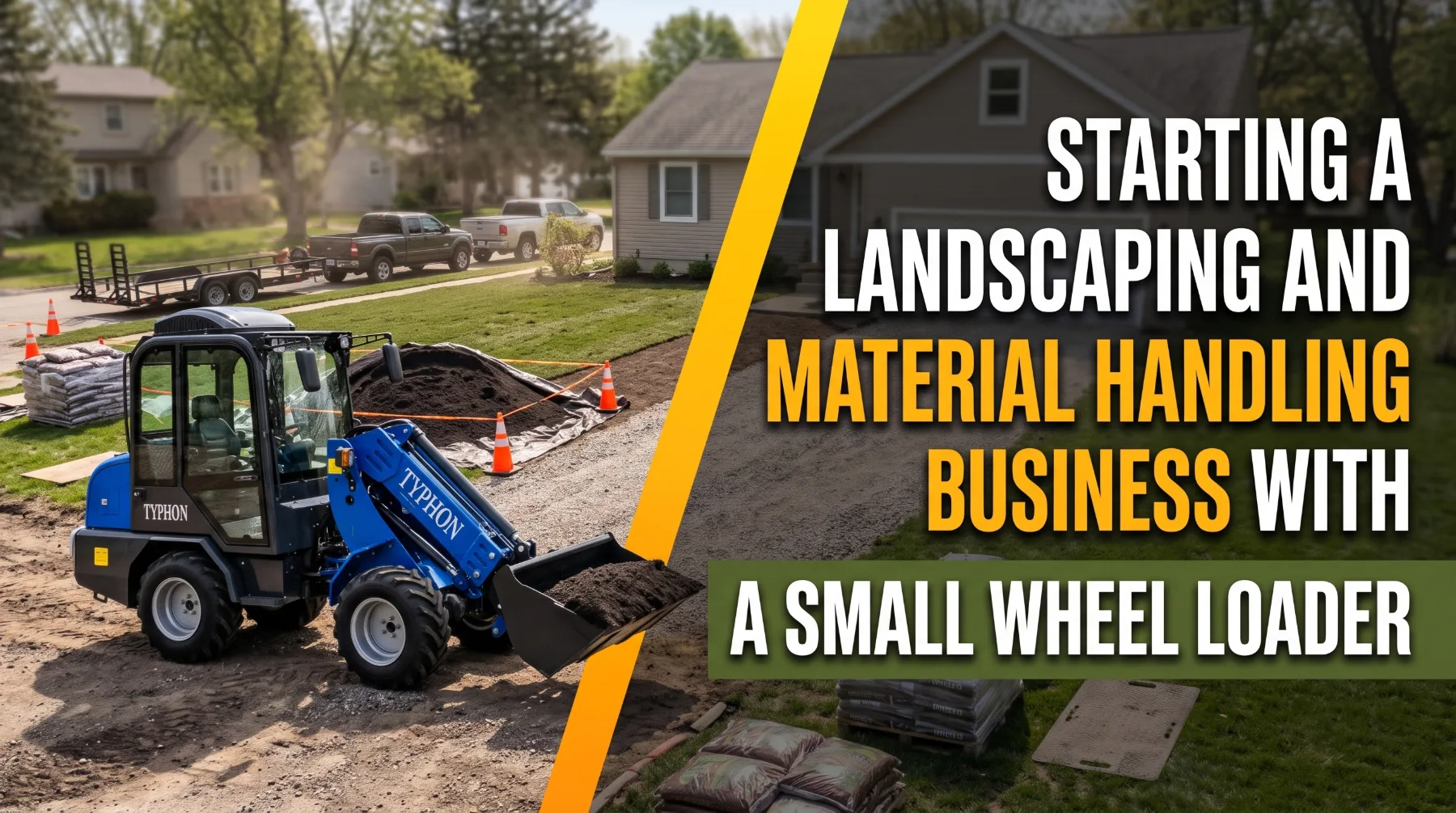
A small wheel loader can support landscaping and material handling services including soil distribution, gravel placement, pallet unloading, debris clearing, and driveway maintenance. For tradespeople, independent operators, and landscapers moving into equipment ownership, a compact loader offers a practical starting point. Building a sustainable business, however, requires more than purchasing a machine. Market demand, loader selection, attachments, transport, insurance, pricing, maintenance, and customer relationships all shape whether the operation becomes profitable.
Owners who match the machine to real job requirements, plan startup and operating costs accurately, and build reliable customer relationships are better positioned for long-term success. Those who rely on equipment capability alone often face underpriced jobs, unexpected costs, and avoidable incidents.
Identifying Landscaping and Property Service Demand
Wheel loader material handling covers a wide range of services. Before purchasing equipment, identify which services your local market actually supports. Common options include soil and topsoil distribution for new lawns, garden beds, and grading projects, gravel placement and driveway regrading, mulch and landscape material delivery, pallet unloading for garden centers and hardscape crews, debris and brush clearing, site cleanup and backfill for builders, and snow pushing and loading for parking lots and driveways.
Few new businesses can offer all of these well on day one. Choose a core set that matches a small loader's size and the attachments you can afford, then expand as demand and cash flow allow. Before committing, gather information from landscape supply yards, local trades such as landscapers and small builders, building permit records, and property managers. These sources identify where customers are underserved.
A clear service focus also simplifies equipment decisions. Residential lawn preparation and driveway work suits a compact machine with turf-friendly tires. Commercial snow removal and gravel lot maintenance may require a larger loader with a wider pusher. Matching your focus to your machine avoids paying for capability you won't use. Build seasonal variation into your financial plan from the start, since landscaping demand often peaks in spring and fall. Snow removal, storm cleanup, and winter site preparation can smooth income through slower months.
Key takeaway: Research local demand through suppliers, trades, construction activity, and property managers before buying equipment, choose a focused set of services that match a small loader's capabilities, and plan for seasonal income variation.
Selecting a Loader for Intended Tasks
The right loader fits your most common jobs, not the largest machine you can finance. Review the following specifications against the work you expect to do: operating weight, rated operating capacity, full-turn static tipping load, bucket capacity, dump clearance and reach, overall width and height, turning radius, and auxiliary hydraulic flow and pressure.
For residential work, measure the gates, side yards, and driveways typical of the properties you plan to serve. A loader that is too wide or too heavy can turn a profitable job into a lost day or a damaged lawn. Confirm that the machine includes a rollover protective structure, seat belt, working backup alarm, mirrors, and lights. Have any used machine inspected by a qualified technician before purchase.
Transport requirements also matter. Add the machine's operating weight, attachments, and trailer weight, then compare the total against the trailer's GVWR, axle ratings, hitch ratings, and the towing vehicle's gross combined weight rating. The lowest rating governs. Depending on combined weight, your setup may require trailer brakes, a breakaway system, commercial registration, or a commercial driver's license.
Key takeaway: Choose a loader based on your most common jobs by comparing rated operating capacity, full-turn tipping load, dimensions, dump clearance, and auxiliary hydraulics, have any used machine inspected by a qualified technician, and confirm your truck and trailer can legally haul it.
Attachments for Expanded Service Options
Each compatible attachment can open an additional service offering without requiring another machine. Common choices for landscaping and material handling include a general-purpose bucket for soil and gravel, a light-material bucket for mulch and wood chips, a 4-in-1 multipurpose bucket for grabbing and grading, pallet forks for staging materials, a grapple for brush and debris, a snow pusher or blade for winter contracts, and a sweeper for paved surface cleanup.
Every attachment must match the loader's mounting system, hydraulic connections, and approved operating limits. Before buying or renting, confirm coupler type and mounting dimensions, auxiliary hydraulic flow and pressure requirements for powered tools, and the attachment's own rated capacity. Running a powered attachment that needs more flow than the loader provides leads to slow performance and excess heat.
Start with two or three attachments covering core services. Renting specialty attachments for single jobs lets you test a new service before committing to a purchase. Track revenue generated per attachment to identify which tools earn their cost.
Key takeaway: Attachments expand services without requiring another machine, so confirm coupler and hydraulic compatibility, subtract attachment weight from available payload, respect fork load centers, and build your attachment lineup gradually based on proven demand.
Startup Budget and Business Expenses
A realistic budget is one of the strongest predictors of first-year survival when starting a wheel loader business. Startup expenses commonly include the loader purchase or financing, attachments, trailer and towing vehicle upgrades, insurance, business registration and licensing, safety equipment, tools and supplies such as a grease gun and ground protection mats, storage, marketing, and accounting software.
Recurring expenses accumulate quickly once work begins. These include fuel for the loader and towing vehicle, routine maintenance, filters, fluids, grease, repairs, replacement parts, tires and cutting edges, insurance premiums, loan payments, trailer maintenance, phone and software subscriptions, disposal and dump fees, and taxes including self-employment tax. Many owners underestimate smaller recurring costs until year-end totals make them visible. Track expenses from day one.
Talk with an insurance agent who works with contractors about general liability, equipment coverage, commercial auto, and workers' compensation where required. Many commercial customers require proof of insurance before work begins. Consult a qualified attorney or accountant about the appropriate business entity structure, and work with a tax professional before making large purchases based on depreciation assumptions.
If you hire operators, confirm they are trained and qualified for the equipment they operate. Before any ground disturbance, contact the local one-call utility locating service, often by dialing 811, and wait for all lines to be marked.
Key takeaway: Budget for every startup and operating cost including insurance, transport, maintenance, and disposal fees, build a cash reserve for slow periods and repairs, track expenses from day one, and obtain qualified insurance, legal, and tax guidance before major decisions.
Pricing Jobs and Managing Customer Expectations
Most compact loader services use one or more of these pricing approaches: an hourly rate for jobs with uncertain scope, a per-job fixed price for a defined scope of work, a per-unit rate for repeat material handling such as cubic yards spread or pallets unloaded, or seasonal and contract pricing for snow removal and recurring property maintenance. Many businesses combine models depending on the service type.
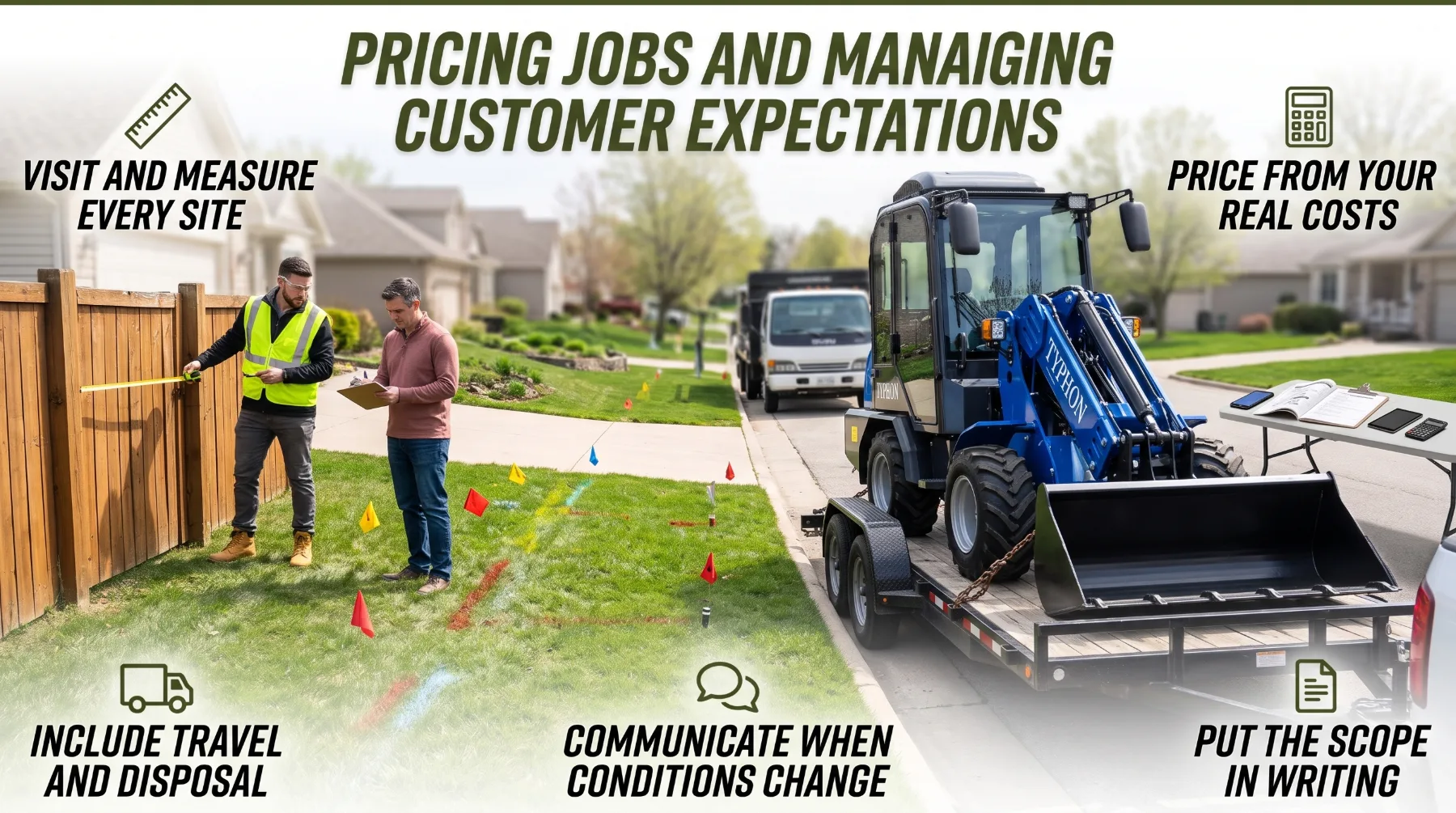
Accurate pricing requires knowing the actual cost to operate the loader for one hour. Add annual fixed costs, then add variable costs per hour, then add your target wage and profit margin. Price from real costs, not estimates based on competitor rates or general expectations.
Each estimate should account for travel time and mobilization, site access conditions such as gate width and slope, ground conditions that may require mats or additional setup, material type and density, disposal fees and haul distance, any attachments required, additional labor for hand finishing, and weather risk. Omitting these factors consistently leads to jobs that cost more than they earn.
A site visit before quoting prevents most pricing errors. Measure gates and passages, observe slope and ground conditions, note travel distance from material drop to work area, and photograph existing site conditions including any existing damage to driveways or curbs. Ask about buried utilities, private irrigation lines, and other subsurface features.
Use written agreements on every job. A clear estimate or contract should identify the scope of work and materials, what is and is not included, the price and pricing basis, how additional work will be handled, payment terms and deposit requirements, expected schedule, weather delay provisions, and responsibility for marking private utilities and relocating obstacles. Request signed acceptance before starting larger jobs and issue written change orders for any scope additions.
Key takeaway: Price from your real cost per hour, include travel, access, disposal, and weather in every estimate, visit the site before quoting, put scope and payment terms in writing, and communicate clearly when conditions change.
Customer Development and Equipment Maintenance
Repeat customers provide more consistent income than one-time residential calls. Priority customer groups include landscape contractors who need a loader on installation days, small builders and remodelers requiring backfill and cleanup, property managers and homeowner associations with ongoing grounds and snow needs, nurseries and garden centers needing unloading support, and homeowners who become referral sources. Introduce yourself in person and follow up after every job to confirm satisfaction.
Reliability is often the primary reason customers return. Arrive on time, communicate promptly when weather or breakdowns require rescheduling, and leave every site in clean condition. Protect lawns with ground mats, sweep driveways after material work, and repair minor turf damage before leaving. Low-cost marketing tools include an online business profile with job photos and customer reviews, clear contact information on the truck and trailer, before-and-after photos on social media, and participation in a local chamber of commerce or contractor association.
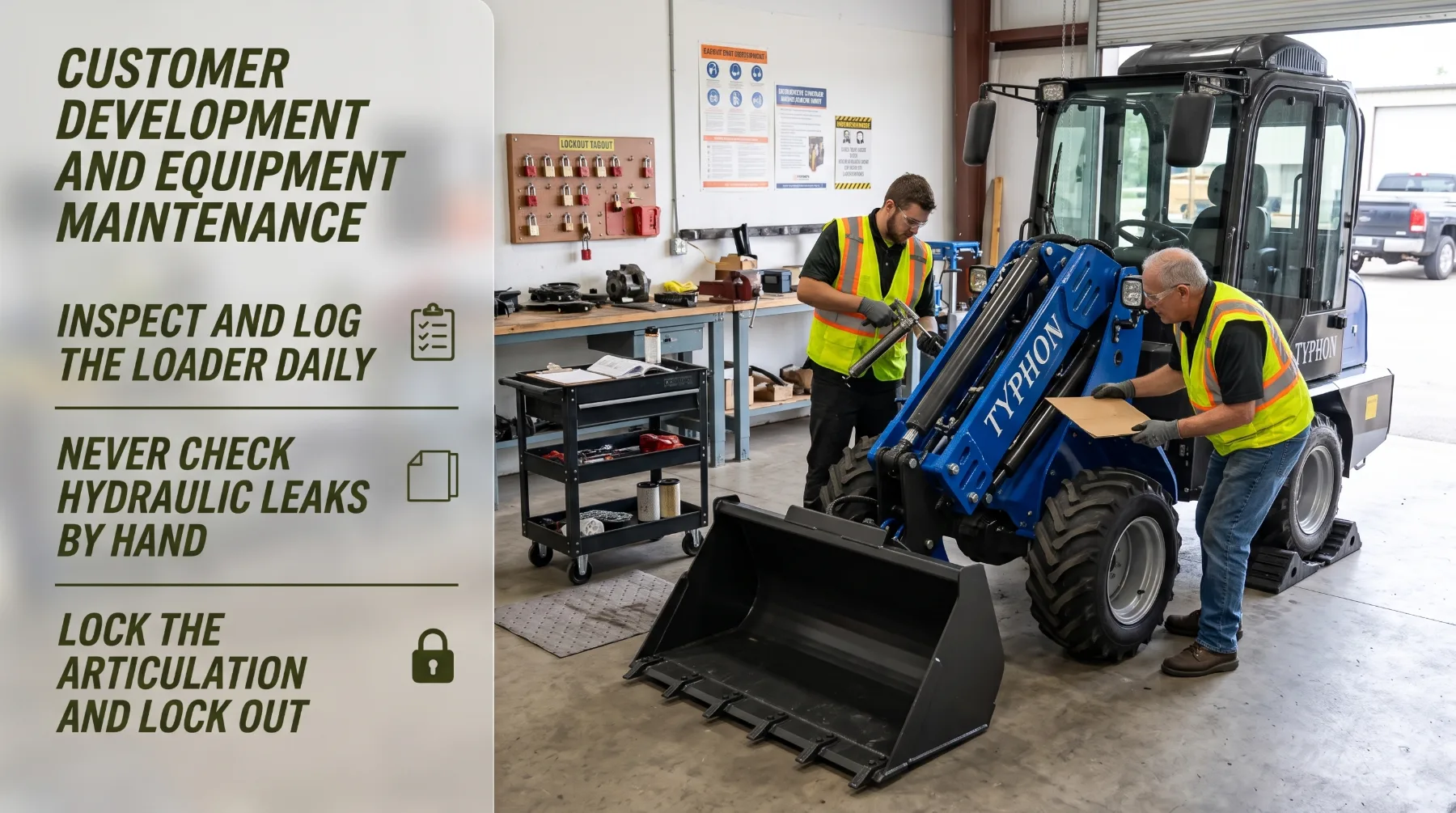
A loader that breaks down mid-job costs both the day's revenue and potentially the customer relationship. Before each shift, inspect engine oil, coolant, and hydraulic oil levels, the air filter restriction indicator, radiator and cooler cores for debris, tires for damage and correct inflation, bucket cutting edge and attachment latches, lift and tilt cylinders for leaks and drift, hydraulic hoses for damage and wear, the articulation joint, and all safety devices including the seat belt, backup alarm, lights, horn, mirrors, and cameras. Keep a service log in the cab and grease pivot points at the specified intervals.
Key takeaway: Build repeat relationships through reliable service and clear communication, inspect the loader every shift and log findings, check leaks with cardboard rather than your hands, stay clear of the articulation joint, and complete the full lockout sequence before any service.
Conclusion
A small wheel loader supports a landscaping and material handling business by providing efficient, versatile capability for soil movement, gravel loading, debris clearing, pallet handling, and property maintenance. Building a sustainable business around that capability requires selecting the right machine for the actual work, controlling startup and operating costs, pricing jobs from real cost data, and developing reliable customer relationships.
Owners who match their loader and attachments to their most common tasks, build accurate financial plans, put agreements in writing, and maintain their equipment consistently give their businesses the best foundation for long-term growth.
Frequently Asked Questions
What services can a small wheel loader business provide?
Common services include topsoil and mulch spreading, gravel placement, driveway regrading, pallet unloading, debris and brush clearing, site cleanup and backfill, and material delivery. With compatible attachments, many operators add snow pushing, sweeping, and grapple work to expand revenue and reduce seasonal income gaps.
Is a small wheel loader suitable for residential jobs?
It can be suitable when its width, operating weight, and turning radius match the site's access and ground conditions. Measure gates and side yards during the site visit, use turf-friendly tires or ground protection mats on lawns, and confirm the loader's rated capacity for the materials you plan to handle.
Which attachments are most useful for a landscaping business startup?
A general-purpose bucket, pallet forks, and a light-material bucket cover many common landscaping tasks. A grapple, 4-in-1 bucket, sweeper, or snow pusher can add services as demand is proven. Every attachment must match the loader's coupler type, hydraulic output, and approved operating limits.
What costs should a new loader business plan for?
Plan for the loader and attachments, trailer and towing vehicle, insurance, registration and licensing, safety equipment, storage, and marketing. Ongoing costs include fuel, maintenance, repairs, tires and wear parts, loan payments, disposal fees, and taxes. Maintain a cash reserve to cover slow periods and unexpected repairs.
SkidSteers.online Featured Equipment
Looking for top-performing heavy equipment, authentic attachments, and dependable jobsite power? Explore verified models backed by manufacturer warranty and nationwide delivery.
View Specifications & Pricing →