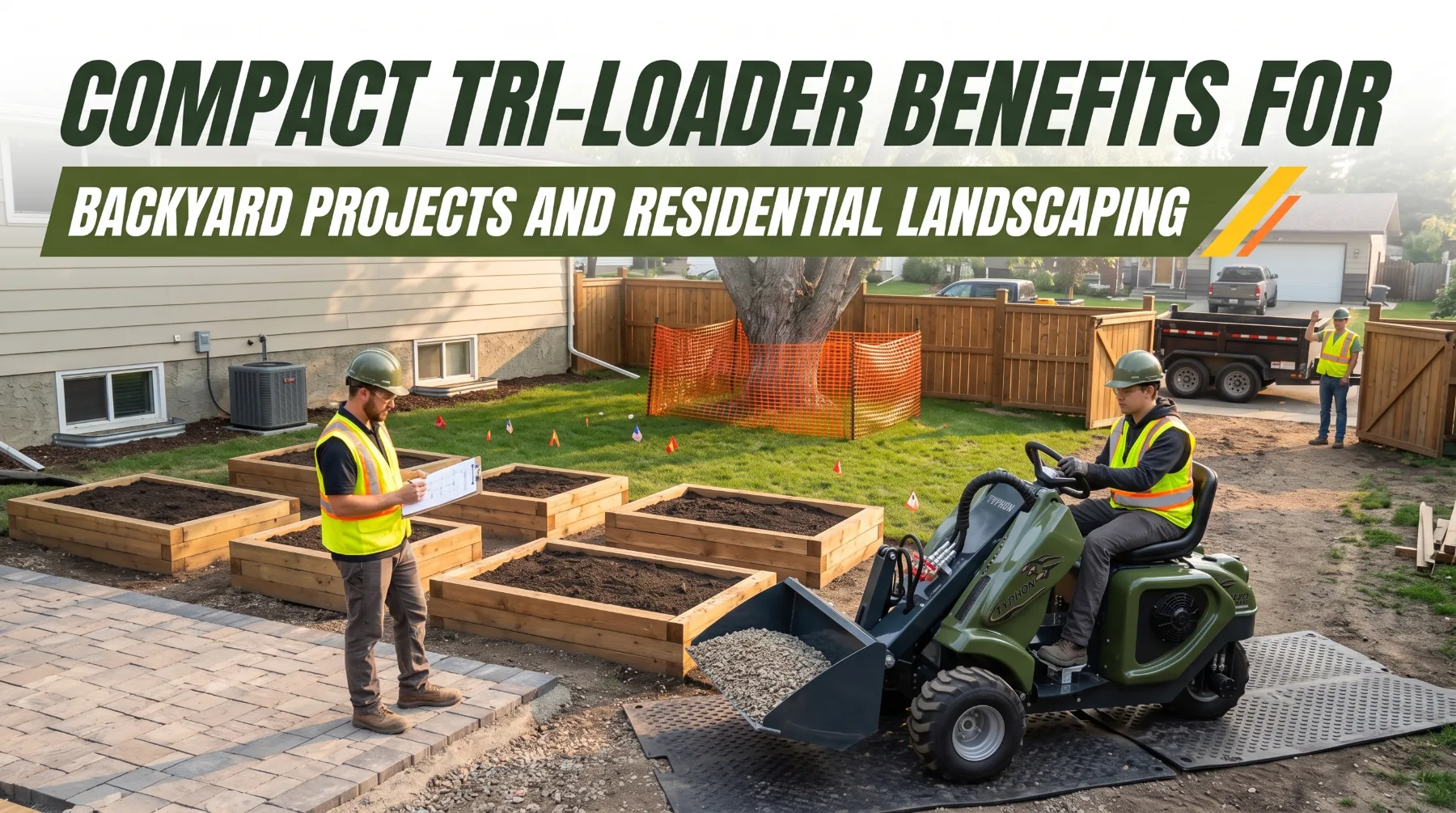
Residential landscaping projects often require moving large quantities of soil, gravel, mulch, pavers, and demolition debris through narrow side yards and restricted access points. Compact tri-loaders can reduce repetitive wheelbarrow trips and support tasks such as grading, material placement, and site cleanup. Their benefits depend on selecting a machine that fits the property and planning movements around lawns, irrigation systems, buildings, and nearby residents.
Machine width, attachment dimensions, ground conditions, turning space, and lifting capacity all affect performance in confined backyards. Wet turf can rut under repeated travel or sharp turns, while unsuitable attachments may scrape gates or damage surrounding features. Existing irrigation lines, overhead restrictions, nearby windows, and pedestrian access also need consideration when planning the work area and machine route.
Successful residential projects begin with measuring access points, choosing suitable attachments, and protecting vulnerable surfaces with appropriate ground mats. Operators should travel carefully, avoid unnecessary turns on soft ground, and use barriers and spotters where people could enter the work zone. Shutting down equipment when it is not needed, maintaining clear communication with homeowners, and planning material movements efficiently help reduce disruption while keeping landscaping work productive and controlled.
Moving Landscaping Materials
With access confirmed, the tri-loader's greatest strength comes into play. Backyard projects depend on moving material between a driveway or curb, a staging area, and the work zone. Soil, mulch, gravel, bedding sand, pavers, wall block, plants, and green waste all need to travel the same route, often many times over. A compact tri-loader can move larger quantities in each trip and reduce the repetitive wheelbarrow runs that wear down crews and stretch schedules.
The benefit goes beyond speed. Fewer manual trips mean less pushing, lifting, and twisting, which lowers the risk of back, shoulder, and wrist strain. Workers who aren't exhausted from hauling stay sharper for skilled tasks such as setting pavers, building wall courses, and finishing grade. Debris removal benefits too. Old decking, broken concrete, sod, and roots can be carried out to a dump trailer or roll-off container quickly, keeping the backyard clear and safe to work in.
Operators must account for material density and stay within the machine's rated capacity. A bucket of wet topsoil, crushed stone, or bedding sand weighs far more than the same volume of mulch or compost. Pallets of pavers and wall block are often heavier than they look. Use delivery tickets, bag labels, and supplier data to confirm weights, and check the capacity chart or decal for the attachment installed, since forks, grapples, and heavier buckets reduce the capacity available for material.
Load position matters just as much as weight. Carry loads low and close to the machine, insert forks fully under pallets, and keep material evenly distributed in the bucket. Raise loads only when the machine is stopped and positioned for placement. Reduce load sizes when the ground is soft, the route includes a slope, or the material is wet. Never allow anyone to stand or walk beneath a raised load.
Key takeaway: A compact tri-loader moves landscaping materials and debris in fewer trips than manual hauling, but every load must stay within the rated capacity for the installed attachment and be carried low and close to the machine.
Supporting Grading and Site Preparation
Next comes the work that shapes the finished landscape. Many backyard projects need more than material transport. Low spots must be filled, planting beds prepared, patio areas leveled, and soil spread evenly before sod, seed, or pavers go down. With suitable attachments, a compact tri-loader can help with spreading soil, moving debris, preparing garden beds, and performing selected surface-level grading tasks.
A bucket can backdrag loose soil to rough grade, while a grading or leveling attachment, where approved for the machine, can help produce a smoother surface. Grapples handle brush, roots, and old landscape timbers during cleanup. Augers, where the machine's auxiliary hydraulics support them, drill holes for fence posts, deck footings, and trees. Each attachment expands what one machine can accomplish, which saves crews time and reduces the number of machines on a small property.
The machine should be matched to the required finish and the condition of the ground. Drainage corrections deserve special care. Grading near a house should direct water away from the foundation, often following a slope set by local codes or the project design. Check finish grades with a level, a laser, or a string line rather than by eye. Compact fill in lifts where the plan requires it, since loose material spread in a single thick layer can settle later and create new low spots.
Some tasks fall outside what a tri-loader should handle. Precise fine grading, deep excavation for footings or drainage systems, and heavy compaction may need additional equipment or a different attachment. Before any digging, contact your local one-call locating service, which you can reach by calling 811 in the United States, and wait for utility owners to mark their lines. Public locators don't mark private lines, so ask homeowners about irrigation, landscape lighting, invisible pet fences, septic systems, and service lines to sheds or pools. Expose marked lines by hand within the tolerance zone before using the bucket nearby.
Key takeaway: Suitable attachments let a tri-loader spread soil, prepare beds, clear debris, and perform surface-level grading, but match each task to the machine's capabilities, locate utilities before digging, and bring in other equipment when deeper or more precise work is required.
Protecting Lawns and Existing Surfaces
Backyard projects carry a responsibility that many commercial jobs don't. The finished landscape, the parts of the yard that aren't being rebuilt, and the homeowner's trust all depend on how carefully the machine treats existing surfaces. Compact equipment can still damage turf, pavers, concrete, irrigation lines, and buried utilities. A muddy rut or a cracked walkway can overshadow weeks of quality work.
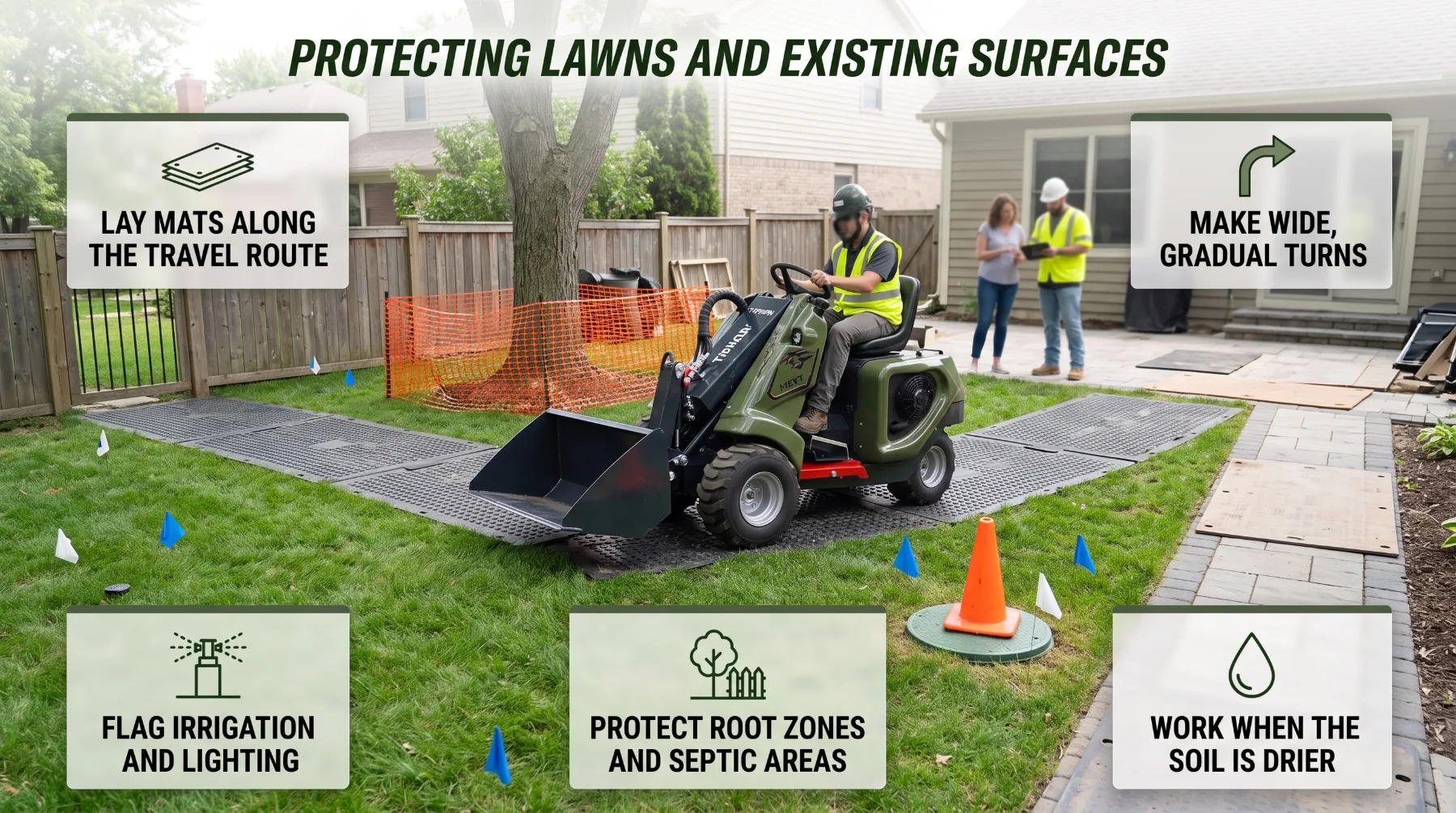
Machine movement can damage lawns, landscaping, and finished surfaces if ground conditions are not considered. Planning travel routes, choosing suitable equipment, and protecting vulnerable areas help reduce rutting, soil compaction, and costly repairs.
Assess Ground Conditions: Consider machine weight, tire or track type, ground pressure, and soil moisture before starting work. Avoid operating on soft or wet ground whenever possible, as it is more likely to develop deep ruts.
Plan and Protect Travel Routes: Establish consistent travel paths and use machine-rated ground protection mats or plywood panels across lawns, landscaping, and finished paving where appropriate.
Use Careful Turning Techniques: Avoid unnecessary turns and pivoting in place on grass. Make wide, gradual turns on protected surfaces or areas already scheduled for excavation.
Identify Hidden Hazards: Locate sprinkler heads, valve boxes, landscape lighting, drainage features, and underground systems before moving the machine. Confirm the locations of septic tanks, drain fields, and cisterns with the property owner.
Protect Trees and Unstable Edges: Keep repeated machine traffic away from tree root zones and use suitable protection where necessary. Maintain a safe distance from retaining walls, excavation rims, and other areas where the ground may collapse.
Key takeaway: Plan consistent travel routes, use rated ground protection, avoid sharp turns on turf, work when soil is drier, and flag irrigation, lighting, septic systems, and root zones before the machine moves.
Improving Productivity in Confined Areas
Once access and protection are in place, a compact tri-loader can change the pace of an entire job. In confined backyards, the biggest time losses usually come from moving material by hand over long distances. A tri-loader helps crews move materials closer to the work area and reduces the time spent transporting supplies manually. That keeps installers working on the tasks that actually build the landscape.
Organized loading and unloading points make the difference. Stage materials at the curb or driveway in a logical order, with the first materials needed placed closest to the access point. Set up drop zones inside the backyard near where each material will be used, such as gravel beside the patio area, soil beside the garden beds, and mulch near the planting areas. Plan the sequence of work so the machine doesn't cross freshly placed bases, finished pavers, or newly planted beds. When several landscaping tasks are happening at once, a clear plan keeps the machine and the crew from getting in each other's way.
The machine must still be operated at a controlled speed around buildings, workers, pets, and residents. Residential sites often include people who aren't part of the crew. Children, pets, neighbors, and delivery drivers can appear without warning. Keep gates closed and posted, set up a marked work zone with cones or barriers, and agree with homeowners on when the backyard will be off-limits. Use a trained spotter when visibility is limited, and agree on hand signals before work begins.
Operator habits support productivity as well. Fasten the seat belt every time on machines equipped with a rollover protective structure, since that structure only protects an operator who stays inside it. Keep loads low during travel, approach drop zones squarely, and lower the attachment to the ground whenever the machine stops. Shut off the engine when the machine sits idle near the house to keep exhaust away from windows, doors, and air intakes.
Key takeaway: Organized staging, planned drop zones, and a sensible work sequence let a compact tri-loader keep materials moving in confined areas, while controlled speed and clear work zones protect residents, pets, and crew members.
Access Through Narrow Gates and Pathways
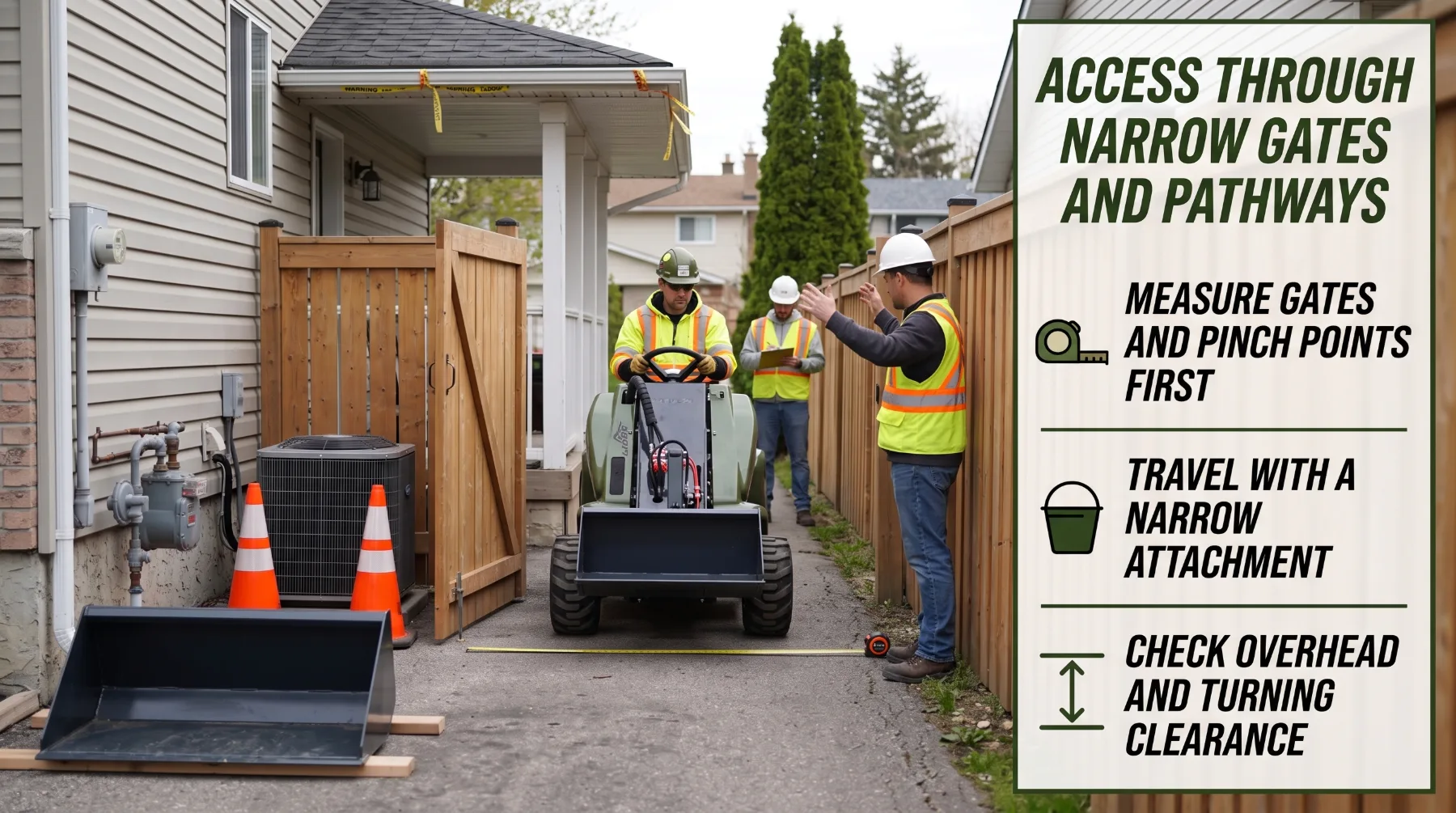
Residential properties rarely offer open access. Narrow gates, side yards, fences, garden walls, retaining walls, and stone pathways often limit how equipment reaches the backyard. On many homes, the side yard is also where air conditioning units, utility meters, downspouts, window wells, and trash bins sit, which narrows the route even further. A machine that can't reach the work area forces crews back to wheelbarrows, no matter how capable it is.
A compact tri-loader can be the right fit when its overall dimensions suit the route and there's enough space to maneuver safely. Contractors should measure access points before delivery, not after the machine arrives. Measure each gate at its narrowest opening, including posts, hinges, and latches. Walk the full route and measure every pinch point between the gate and the work area. Check overhead clearance under porch roofs, eaves, arbors, and tree limbs, keeping in mind that the operator station or protective structure usually sets the machine's tallest point.
Attachment width matters as much as the machine's base width. A wide material bucket or grading attachment may extend past the chassis and strike gate posts, fences, or siding, as it did on the Larkspur project. Many crews travel through tight access with a narrow bucket installed, then switch to a wider attachment once inside the work area. Confirm the overall width in the exact configuration you'll use for each pass.
Turning clearance completes the picture. A machine that fits a straight side yard may not clear a sharp bend at the end of it, especially near decks, steps, and planting beds. Walk every turn and allow extra room so the operator never has to squeeze past structures or people. Where access is especially tight, a trained spotter at the gate helps the operator keep clear of posts, siding, and fixtures.
Key takeaway: Measure gates, side yards, overhead clearance, and turns before delivery, confirm the machine's width with attachments installed, and allow enough room to maneuver safely past every pinch point.
Choosing the Right Setup for Residential Work
The final step is choosing a machine and configuration that suits the property, the scope, and the people around it. Machine width, lifting capacity, attachment options, noise, exhaust, maintenance needs, and transport requirements all influence suitability. A machine that's perfect for one backyard may be too wide, too heavy, or too loud for the next.
Start with the property. Compare the machine's width and height with the narrowest gate, side yard, and overhead clearance, and confirm turning room inside the work area. Then review the heaviest loads the job will involve, such as pallets of pavers or bulk bags of gravel, and check the rated capacity for the attachment you'll use. Choose a tire or track configuration based on the surfaces you'll cross, with extra weight given to turf protection on finished lawns. Confirm that the attachments you need fit the machine's mounting system and that its auxiliary hydraulic flow matches any powered tools, such as augers.
Neighborhood factors deserve attention too. Many communities set work hours, and some homeowners associations add their own rules for equipment, parking, and deliveries. Noise and exhaust matter more when the machine works near homes, open windows, and outdoor living spaces. Plan transport as well. Confirm that the trailer and tow vehicle are rated for the machine's weight, and choose an unloading area that won't block driveways or damage curbs.
Contractors should confirm that the machine can reach the work zone without damaging property and that the planned tasks fall within its capabilities. Complete a pre-shift inspection every day, including tires or tracks, attachment locks, hydraulic hoses, controls, and warning devices. Never search for a hydraulic leak with your hands, since pressurized fluid can penetrate skin. Use a piece of cardboard instead. Look overhead for service drops and power lines, and keep at least the clearance required by applicable regulations, which in the United States is generally 10 feet for lines up to 50 kV. Operators should also follow site rules and keep residents and pedestrians out of the operating area.
Key takeaway: Choose a tri-loader setup based on access dimensions, load weights, surfaces, attachments, noise, exhaust, and transport needs, and confirm the machine can reach the work zone without damaging property before the job begins.
Conclusion
Compact tri-loaders help make backyard projects and residential landscaping faster, safer, and more efficient by reducing repetitive manual hauling and supporting controlled material handling. Measuring gates, side yards, narrow passages, and overhead clearance ensures the machine can access the work area without striking structures or landscaping. Moving soil, gravel, mulch, pavers, and debris in fewer trips can reduce physical strain and keep projects on schedule, provided every load remains within the rated capacity for the selected attachment. Compatible attachments expand the machine's usefulness for grading, cleanup, and site preparation, while planned travel routes and suitable ground protection help prevent damage to lawns, irrigation systems, and finished surfaces. Before starting a residential project, walk the property with a tape measure and identify every access restriction, turning point, and overhead obstruction. Confirm the machine's dimensions with the intended attachment installed and check material weights against the applicable capacity limits. Contact the local one-call locating service, confirm utility responses, and ask homeowners about private lines, irrigation, landscape lighting, pet fences, and septic systems. Mark sprinkler heads, valve boxes, drain inlets, lighting, and tree root zones, then install suitable ground protection mats along routes crossing lawns or finished surfaces. Coordinate irrigation schedules and hauling times to reduce damage to wet soil. Stage materials in work order near the driveway or curb, with drop zones close to installation areas to minimize unnecessary travel. Secure gates, mark the work zone, and assign a trained spotter for narrow access points. Review local work hours and applicable homeowners association rules, then inspect tires or tracks, attachment locks, hoses, controls, and warning devices before operation. Shut down the engine when the machine is idle near the house. Careful access planning, utility checks, organized staging, and routine inspections help protect property, improve crew efficiency, and deliver quality residential landscaping results.
Frequently Asked Questions
What backyard tasks can a compact tri-loader handle?
Depending on its configuration and attachments, a compact tri-loader can move soil, mulch, gravel, pavers, and debris, and it can support selected grading and landscaping tasks such as preparing garden beds, spreading soil, leveling patio areas, and clearing brush. With approved powered attachments, it can also help with tasks such as drilling post holes. Deeper excavation and precise fine grading may require additional equipment.
Can a compact tri-loader fit through a narrow gate?
That depends on the machine's actual width, the attachment dimensions, the gate opening, and the available turning space. Measure the gate at its narrowest point, including posts and hardware, and check the full route to the backyard for pinch points and overhead obstructions. Many crews travel through tight access with a narrow bucket installed and switch attachments once inside.
Will a tri-loader damage a lawn?
It can. Ground moisture, machine weight, tire or track design, and turning movements all influence the risk of turf damage. Rated ground protection mats, wide and gradual turns, consistent travel routes, and work scheduled when the soil is drier all reduce the impact. Rubber tracks typically spread weight over a larger area, which can help on soft lawns.
Is a compact tri-loader suitable for every residential project?
No. The equipment must match the site's access, terrain, load requirements, work scope, and surface protection needs. Some properties are too tight for any machine, and some tasks call for different equipment. Evaluating each property before the job starts helps you choose the right setup and avoid surprises once work begins.