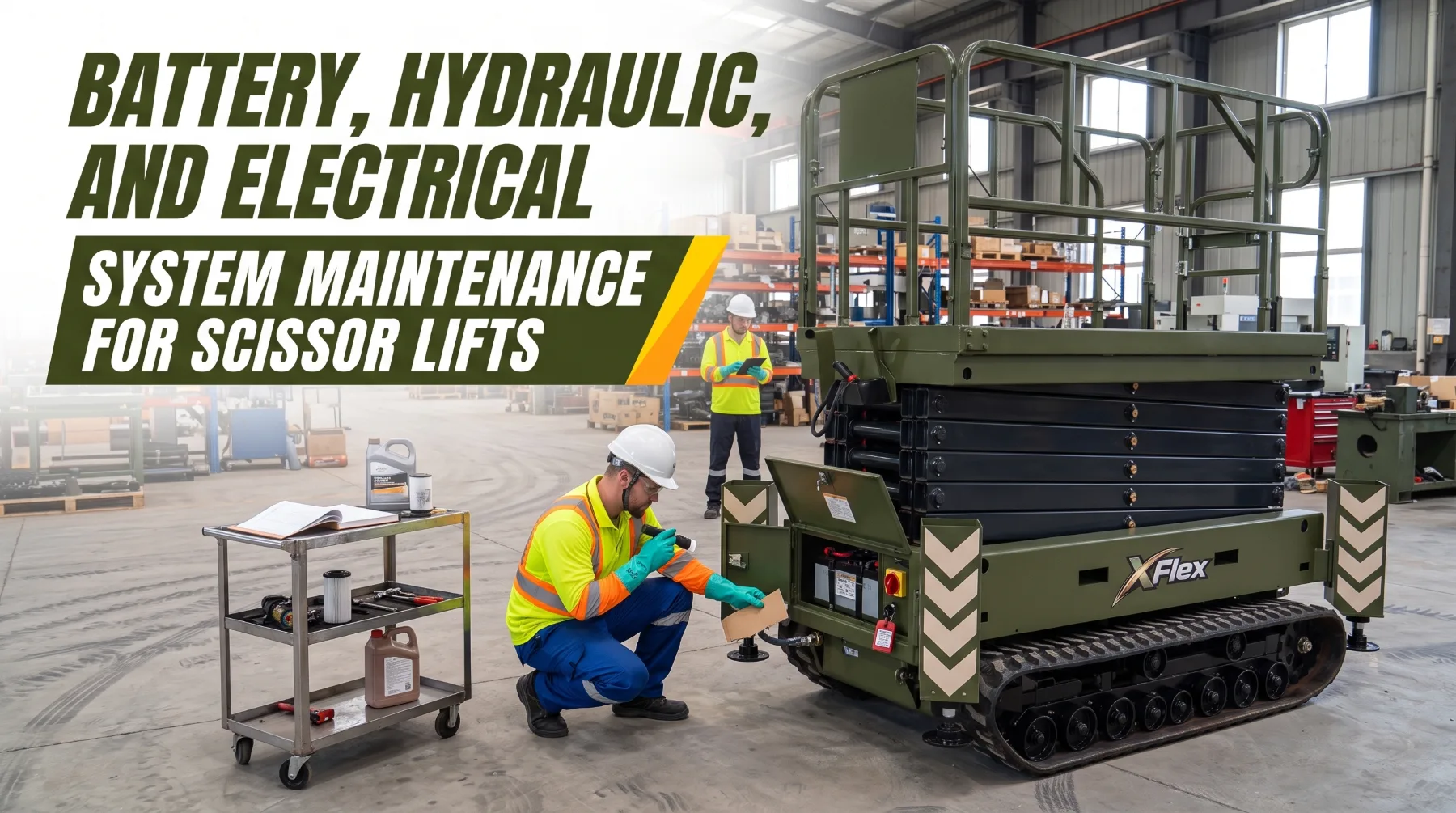
Scissor lifts give crews safe, stable access to ceilings, walls, ductwork, lighting, signage, and building exteriors on construction sites, in warehouses, and inside commercial facilities. They raise workers, tools, and materials to height with smooth, controlled movement, and they lower them back down just as predictably. That steady performance comes from three systems working together. Battery power drives the motors and pump. Hydraulic components raise and lower the platform. Electrical controls manage every function and keep the safety devices active.
When these systems are healthy, the lift responds the way operators expect. The platform rises evenly, holds its position, and descends at a steady rate. Drive and steering respond smoothly, alarms sound when they should, and safety devices stop movement the moment conditions become unsafe. When one system begins to fail, the warning signs often start small. A battery may hold less charge than it once did. Fluid may seep from a fitting. A control may respond late or not at all. Left unaddressed, these minor issues can turn into equipment downtime, missed deadlines, or a lift that cannot be trusted at height.
Consistent maintenance prevents those outcomes. Regular inspections catch defects early, correct charging practices extend battery life, and careful hydraulic and electrical checks keep the lift reliable and safe through every shift. Maintenance also protects the people who depend on the machine, because a scissor lift with a hidden fault puts the operator on the platform and anyone working nearby at risk.
This guide covers each part of a dependable maintenance program, from battery care and hydraulic inspections to electrical systems, the lift mechanism and safety interlocks, safe isolation, and maintenance records. Servicing should always follow the manufacturer's instructions, and repairs should be performed by personnel qualified for the task. When operators, technicians, and fleet managers apply these practices together, scissor lifts deliver the safe, consistent performance every job requires.
Battery Condition and Charging Practices
The battery pack is the power source for most electric scissor lifts. It supplies the energy for the drive motors, the hydraulic pump, the controls, and the safety systems. A healthy battery delivers full runtime and steady performance, while a neglected one can leave a lift stranded mid-shift or cause sluggish lifting and driving. Good battery care is one of the most effective ways to keep a fleet productive and reduce replacement costs.
Scissor lifts may use different battery types depending on the model, including flooded lead-acid, sealed lead-acid, or lithium-based batteries. Each type has its own charging, maintenance, and storage requirements. Flooded batteries usually need periodic water top-ups, while sealed and lithium batteries do not. Always confirm the battery type and follow the manufacturer's instructions for that specific system rather than applying one routine to every machine.
Charging practices have a major effect on battery life. Charge the lift in the designated charging area using the onboard charger or compatible equipment specified for the machine. Lead-acid batteries can release hydrogen gas during charging, so the area must be well ventilated and kept free of open flames, sparks, smoking, and other ignition sources. Keep battery compartment covers open during charging if the manufacturer requires it, and never charge a battery that is frozen, damaged, or visibly leaking.
Follow the charging routine the manufacturer recommends. Many lead-acid batteries perform best when they receive a full, uninterrupted charge at the end of each shift and are not repeatedly run to a very low state of charge. Allowing the charger to complete its full cycle helps balance the cells and protects capacity. Lithium batteries may tolerate different charging patterns, which is another reason to follow the guidance for the specific battery installed.
Watering flooded batteries requires care. Use only the type of water the manufacturer specifies, usually distilled or deionized water. Add water after charging unless the plates are exposed, since filling before charging can cause electrolyte to overflow as it expands. Never overfill. Wear eye protection and chemical-resistant gloves, because battery electrolyte is corrosive and can cause serious injury to skin and eyes. Keep an eyewash station or clean water source nearby.
Corrosion on terminals should be cleaned using the method the manufacturer approves, with the battery disconnected and appropriate protective equipment in place. Never place metal tools across battery terminals, and remove rings, watches, and other metal jewelry before working near the battery pack.
Key takeaway: Inspect batteries, connections, and chargers regularly, charge only in a ventilated designated area with compatible equipment, and follow the manufacturer's charging and watering routine for the specific battery type installed.
Pre-Service Isolation and Safety Checks for Scissor Lift Maintenance
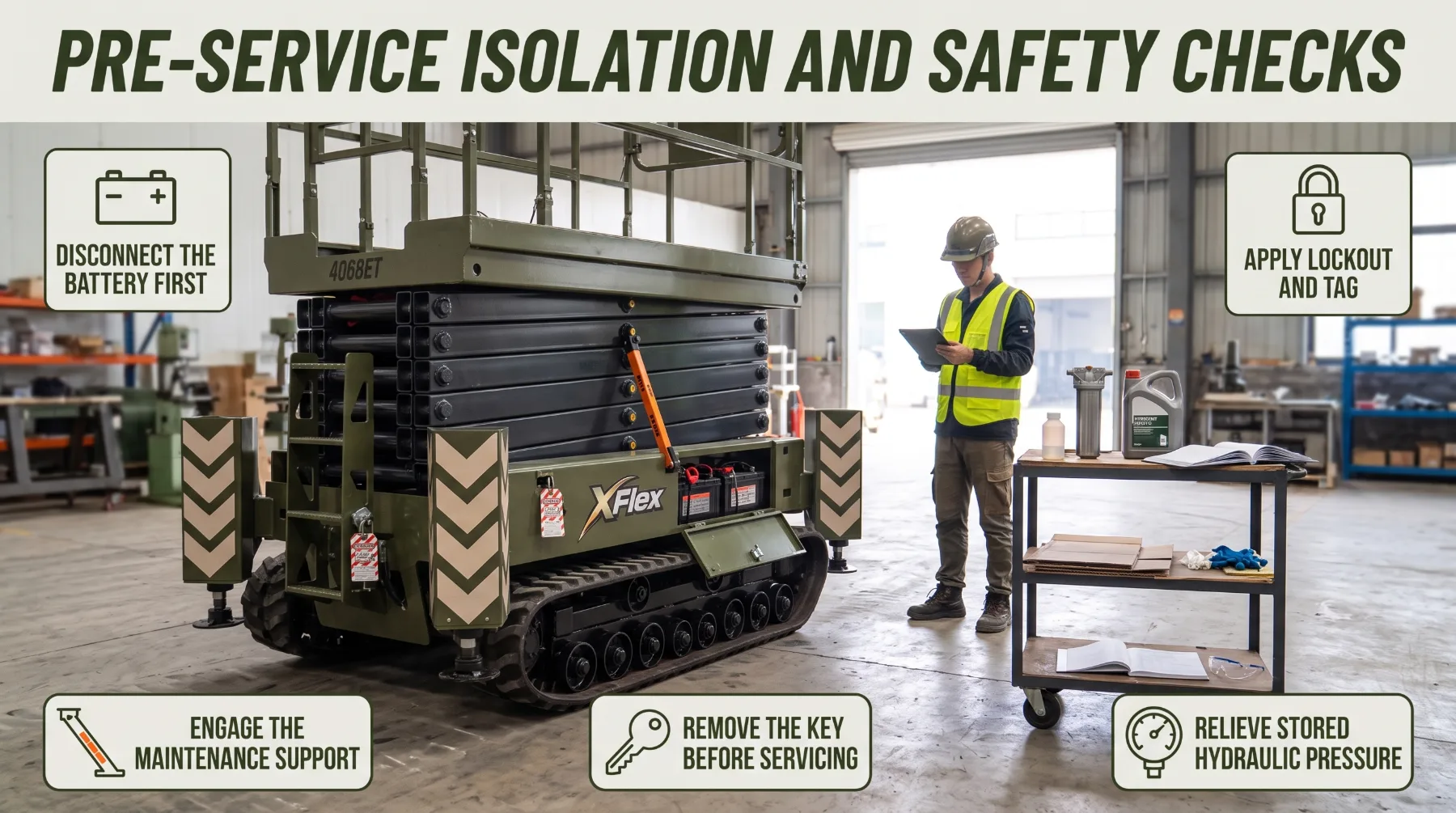
Before servicing a scissor lift, establish a safe work area and isolate the machine from unintended operation. Park on firm, level ground, lower the platform fully whenever possible, apply the parking brake if equipped, and remove the key. Follow the manufacturer's lockout/tagout procedure and isolate the battery or other energy sources as specified for the maintenance task.
Some service tasks require the platform to be raised to access components. In these cases, use the manufacturer's approved maintenance support device and engage it exactly as directed. Never rely on hydraulic pressure alone to support a raised platform. Before working on hydraulic components, follow the prescribed procedure to relieve stored pressure, and verify that all relevant energy sources have been controlled.
Prepare the service area with the correct tools, replacement parts, and personal protective equipment. Inspect the maintenance instructions before opening battery compartments or hydraulic systems, and follow the specified precautions for electrical energy, battery chemicals, and fluid handling. Attach clear lockout tags, keep unauthorized personnel away, and verify that the machine cannot be activated before beginning work.
Key takeaway: Isolate all relevant energy sources, follow lockout/tagout procedures, and use approved maintenance supports before working on scissor lift components.
Hydraulic Fluid and Leak Inspection
The hydraulic system is what lifts the platform. An electric pump pressurizes fluid and sends it to one or more lift cylinders, which extend to raise the scissor stack. Valves control the flow, hold the platform at height, and allow it to lower in a controlled way. Because this system supports workers in the air, its condition deserves close and consistent attention.
Check the hydraulic fluid level according to the manufacturer's procedure. On most scissor lifts, the level should be checked with the platform fully lowered, since raising the platform draws fluid out of the tank and into the cylinders. Use only the fluid type the manufacturer specifies, and never mix fluids of different types. When adding fluid, clean around the fill cap first to keep dirt and debris out of the tank. Contaminated fluid can wear pumps, valves, and seals and lead to erratic lifting.
Never check for hydraulic leaks by running your hand along a hose or fitting. Pressurized fluid can penetrate the skin and cause serious injury that requires immediate medical attention. Use a piece of cardboard or similar material to locate suspected leaks, and wear eye protection when working near hydraulic components.
The emergency or manual lowering system is part of the hydraulic system and must work when needed. Confirm its location, understand how it operates, and test it as the manufacturer directs. This system allows the platform to be brought down safely if power is lost or the controls fail.
A lift with a suspected hydraulic fault should be removed from service until it has been assessed and repaired. Hydraulic repairs should be carried out by qualified personnel, with the platform lowered or properly supported and stored pressure relieved according to the manufacturer's instructions.
Key takeaway: Check fluid levels with the platform fully lowered, inspect hoses, fittings, cylinders, and the pump for leaks and damage, watch for drift or uneven lifting, and keep any lift with a suspected hydraulic fault out of service until it is repaired.
Electrical Wiring and Control Systems
Electrical systems connect every part of a scissor lift. Wiring harnesses carry power from the batteries to the motors and pump. Control modules interpret operator inputs and manage drive, steering, lifting, and lowering. Sensors and switches monitor the machine's position and condition, and safety circuits stop movement when conditions are unsafe. A fault anywhere in this network can cause a function to fail, respond unpredictably, or disable a safety device without warning.
Visual inspection catches many electrical problems before they cause failures. Look for damaged or cracked insulation, pinched or chafed wiring, loose or corroded connectors, missing cable ties or clamps, and wires routed where they can be crushed by the scissor stack. Pay particular attention to the cable that runs from the base to the platform, since it flexes every time the lift rises and lowers. Check that control boxes are securely mounted, that switches and buttons are labeled and undamaged, and that protective covers and boots are in place.
Function checks confirm that the controls respond correctly. From both the ground and platform controls, test every function and confirm that it moves in the right direction and at the expected speed. Each control should return to neutral and stop movement when released. The enable trigger or function switch should be required for movement, and the emergency stop at each control station should cut all functions immediately. Test the horn, movement alarms, descent alarm, and warning lights as well.
Unexpected movement is a serious fault. Stop using the lift immediately, lower the platform safely if possible, and keep the machine out of service until it is repaired.
Electrical inspection and repair must follow the manufacturer's isolation requirements. Disconnect the battery as directed before working on wiring or components, and never bypass fuses, switches, or circuits to restore a function. Repairs to control modules, motor controllers, and safety circuits should be performed by personnel qualified to work on the equipment's electrical systems, using approved replacement parts.
Keep the electrical system protected from its environment. Avoid pressure washing control boxes, connectors, and electrical compartments unless the manufacturer permits it. Keep control boxes covered when the lift is stored outdoors, and clean dust and debris from electrical compartments using approved methods.
Key takeaway: Inspect wiring, connectors, and control boxes for damage, test every function and emergency stop from both control stations, treat unexpected movement as a critical fault, and leave electrical repairs to qualified personnel following proper isolation.
Maintenance for Battery, Hydraulic, and Electrical Reliability
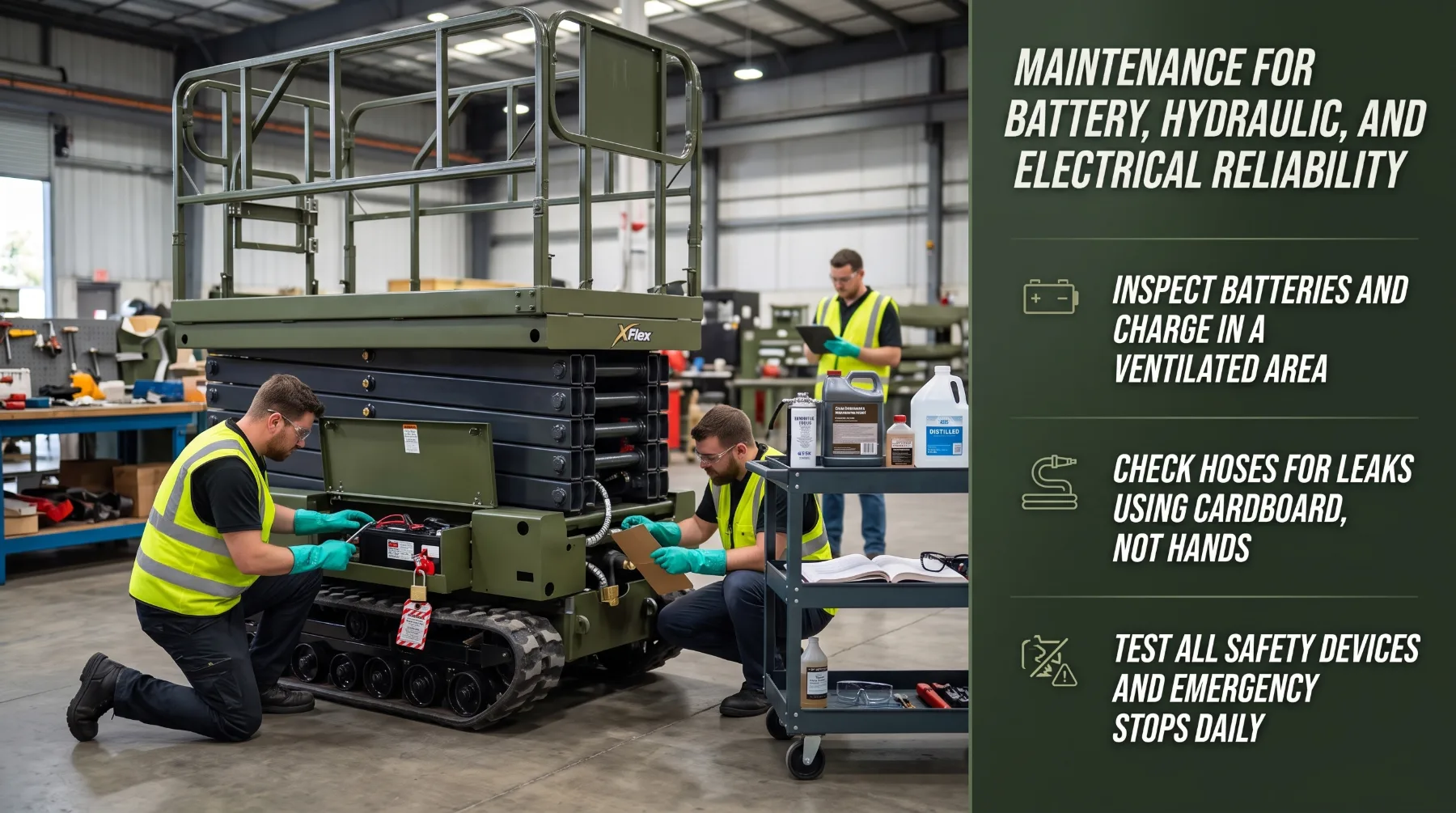
Regular maintenance helps preserve a scissor lift's battery performance, hydraulic operation, and electrical reliability. Inspect battery connections, cables, terminals, charger connections, and visible wiring for corrosion, looseness, wear, or damage. Follow the manufacturer's battery-specific instructions, since battery types differ in their charging, cleaning, and electrolyte requirements. Never add distilled water unless the battery design and manufacturer instructions require it.
Hydraulic system checks should include hoses, fittings, cylinders, filters, and visible connections. Look for abrasion, cracks, loose fittings, and fluid leaks, and use the specified hydraulic fluid and replacement parts. Never use bare hands to locate a suspected hydraulic leak because high-pressure fluid can penetrate the skin. Use cardboard or another suitable method from a safe position, and ensure the system is shut down and pressure is relieved as directed before servicing.
Safety devices must remain reliable as well. Inspect and test emergency stops, platform and ground controls, interlocks, alarms, and other safety features according to the manufacturer's inspection schedule. Record maintenance results, address defects promptly, and remove the lift from service if a safety-critical function fails. Only return it to operation after the required repairs and checks are complete.
Key takeaway: Maintain the battery, hydraulic system, and electrical connections according to the manufacturer's schedule, and verify that all safety devices work before returning the lift to service.
Scheduled Maintenance and Safe Isolation Procedures
Daily inspections catch obvious problems, but scheduled maintenance keeps a scissor lift in reliable condition over its full working life. Manufacturers set service intervals for tasks such as fluid and filter changes, lubrication, structural inspections, battery service, and detailed function testing. These intervals are based on operating hours, calendar time, or both, and they should be followed closely.
Adjust the schedule for the conditions the lift actually works in. Machines that operate long hours, work in dusty or corrosive environments, travel on rough outdoor surfaces, or sit unused for long periods may need more frequent service. Lifts that have been in storage should receive a thorough inspection and function test before returning to work. Periodic and annual inspections should be completed by qualified personnel familiar with the specific model.
Raised platforms require particular care. Never work beneath a raised platform or reach into the scissor stack unless the platform is supported by the manufacturer's approved maintenance support, such as a safety arm or prop. Hydraulic pressure alone must never be relied on to hold the platform up, because a hose failure, valve fault, or accidental control input can cause it to lower without warning. Follow the manufacturer's procedure for engaging the support, which typically involves raising the platform to a specified height, positioning the support, and lowering the platform onto it before shutting down.
Use appropriate protective equipment for each task, including eye protection, gloves, and safety footwear. Keep the work area clear of unauthorized people and secure tools so they cannot fall from the platform or into the mechanism. Use only approved replacement parts and fluids, and confirm that all guards, covers, and panels are reinstalled before the lift returns to service.
After maintenance, restore power according to the manufacturer's procedure, remove the maintenance support, and complete a full function test from both control stations before releasing the machine for work.
Key takeaway: Follow the manufacturer's service intervals and adjust them for working conditions, isolate electrical, hydraulic, and stored mechanical energy before servicing, and never work beneath a raised platform without the approved maintenance support in place.
Maintenance Records and Fault Reporting
Maintenance is only as effective as the information behind it. Accurate records show what has been inspected, what has been repaired, and what still needs attention. They help technicians spot recurring problems, help managers plan service and replacements, and provide clear evidence that each lift is in safe working condition before it is used.
When a defect affects safe operation, the lift should be removed from service immediately. Tag the machine clearly as out of service, remove the key where site procedures require it, and inform the supervisor or maintenance team. The tag should stay in place until qualified personnel have corrected the problem and confirmed the lift is safe. This step prevents another operator from unknowingly using a machine with an unresolved fault.
Close the loop on every report. Record what was found, what repair was made, and who confirmed the lift was ready to return to service. Review records periodically for patterns, such as repeated battery failures on one unit or recurring hose damage in the same location. These patterns often reveal a root cause, such as an incorrect charging habit or a routing problem, that can be corrected to prevent future downtime.
Key takeaway: Keep detailed records of inspections, repairs, and safety tests for every lift, make fault reporting simple and expected, and tag defective lifts out of service until qualified personnel confirm they are safe to use.
Conclusion
Battery, hydraulic, and electrical system maintenance is essential for safe, reliable scissor lift operation. The battery supplies the power, the hydraulic system raises and holds the platform, and the electrical controls manage every movement and safety function. Each system depends on the others, and a weakness in any one of them can affect the entire machine.
Correct charging practices and regular battery inspections protect runtime and extend battery life. Careful hydraulic checks catch leaks, drift, and contamination before they compromise lifting performance. Thorough electrical inspections and function tests keep controls responsive and safety circuits active. Close attention to the scissor mechanism and safety interlocks confirms that the lift will hold its position and stop when conditions become unsafe. Safe isolation procedures protect the technicians who perform the work, and accurate records with prompt fault reporting make sure no defect is overlooked or forgotten.
Every repair should follow the manufacturer's procedures and be completed by qualified personnel. Any lift with a safety-related defect should stay out of service until the problem is corrected, no matter how small the task or how tight the schedule.
Make maintenance a routine part of every shift. Inspect the batteries and charger, check for leaks with the platform lowered, test every control and safety device, and report anything unusual right away. When operators, technicians, and managers commit to these practices together, scissor lifts deliver the dependable, safe access that keeps every project moving forward with confidence.
FAQs
Which safety devices should be tested regularly?
Test the emergency stops at each control station, the tilt alarm and lockout, pothole protection, load sensing system, drive speed limiting, descent alarm, brakes, and horn. Follow the manufacturer's procedures for each test.
Is it safe to work beneath a raised scissor lift platform?
Only when the platform is supported by the manufacturer's approved maintenance support and the lift has been properly isolated. Hydraulic pressure alone should never be relied on to hold the platform up.
What should happen if a scissor lift develops a safety-related fault?
Stop using the lift, lower the platform safely if possible, tag it out of service, and report the issue. Keep the lift out of service until qualified personnel have corrected the problem and confirmed it is safe.
Why are maintenance records important?
Records track inspections, repairs, and safety tests for each machine. They help identify recurring problems, support service planning, and confirm that defects were corrected before the lift returned to work.