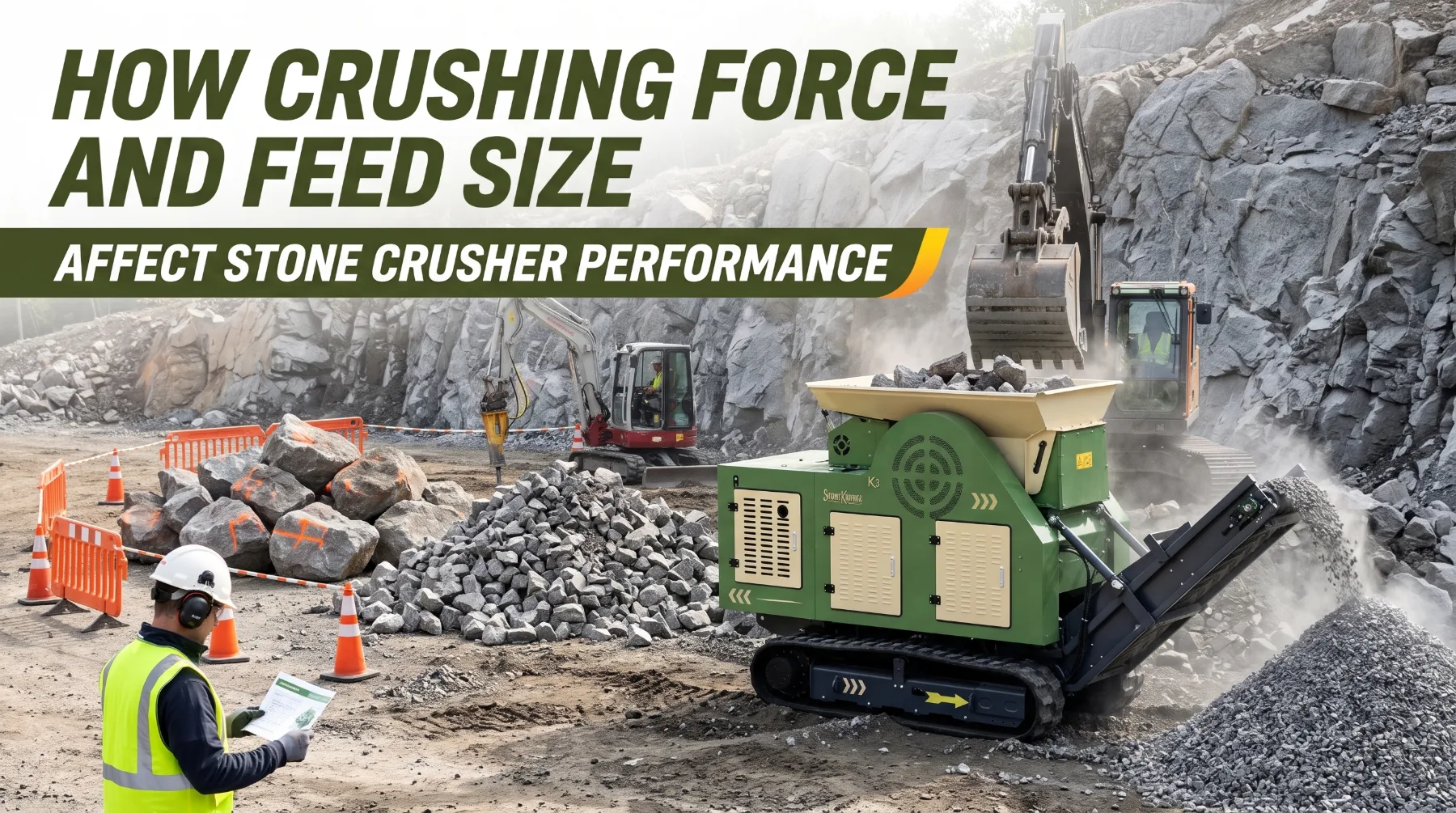
A site development contractor lands a contract to turn blasted granite from a highway cut into base material for the project's access roads. The company already owns a compact horizontal shaft impact crusher. It has run reliably for two seasons on recycled concrete and soft limestone, so the owner expects the same results. On the first morning, the excavator operator loads the hopper with shot rock straight from the blast pile.
Problems appear within the first hour. Large, angular boulders bounce on top of the inlet curtain instead of feeding into the rotor. Others enter but stall the rotor briefly, and the engine lugs before recovering. By midday, the blow bars show heavy wear across their striking faces, and the finished product has drifted coarser as the gap to the impact aprons widens. Production sits at less than half the rate the crew achieved on concrete. By the end of the second day, the blow bars need turning, and the owner faces a wear-parts bill that erases much of the job's margin.
Stone crusher performance depends on how well the machine applies crushing force to the material entering it. Feed size decides whether rock can enter the chamber and be gripped or struck effectively. Rock hardness and abrasiveness decide how much force is needed and how quickly wear parts disappear. The crushing mechanism decides how force is delivered, while discharge settings and feeding consistency decide what comes out and how fast. This guide explains how each factor works and how they connect, so you can select a crusher that produces the aggregate you need at a dependable rate.
Understand Crushing Force
Crushing force is the mechanical force a crusher applies to break rock into smaller pieces. Every crusher converts power from an engine or electric motor into force at the crushing surfaces. How it does that depends on the design. Some crushers squeeze rock between two surfaces until it fractures. Others strike it at high speed and throw it against hard surfaces. The result is the same: rock breaks along its weakest planes into smaller fragments.
Impact crushers work differently. A rotor fitted with blow bars spins at high speed and strikes rock as it falls into the chamber. The rock gains kinetic energy and is thrown against impact aprons or curtains, where it breaks again. Force depends on rotor speed, rotor mass, and blow bar condition. A faster rotor delivers more energy per strike and usually produces finer, more cubical material. It also increases wear.
Manufacturers rarely publish a single "crushing force" figure. Instead, they publish engine or motor power, flywheel or rotor specifications, chamber dimensions, and capacity at given settings. Read those figures together. Power tells you how much energy the machine can supply. Chamber design and settings tell you how that energy reaches the rock. A crusher with ample power but a poorly matched chamber can still struggle. A well-designed chamber with too little power will stall in hard rock.
Crushers also include protection against excessive force. Many jaw crushers use the toggle plate as a designed weak point that fails before the frame or shaft if uncrushable material enters. Many modern compact crushers use hydraulic setting adjustment and overload relief instead. Impact crushers often allow aprons to move back when hit by tramp material. Never bypass, strengthen, or modify these protective features. They exist to prevent major structural damage.
Key takeaway: Crushing force comes from compression or impact, depending on the crusher design. Evaluate power, chamber geometry, and protective systems together, because no single figure describes how well a crusher breaks rock.
Match Feed Size to Machine Capability
Feed size determines the dimensions of material entering the crusher. It is one of the most practical limits on any crushing job. A crusher can only apply force effectively to rock it can accept and grip. Material that is too large wastes time, strains components, and creates hazardous blockages.
Every crusher has a stated feed opening and a recommended maximum feed size. On a jaw crusher, the opening is described by width and gape, the distance between the jaws at the top of the chamber. The maximum feed size is usually smaller than the gape, often about 80 percent of it, so the jaws can grip the rock rather than letting it ride on top. Impact crushers are limited by the inlet dimensions and by the rotor's ability to handle large, heavy pieces. Cone crushers are generally secondary or tertiary machines with much smaller feed limits. Follow the manufacturer's stated maximum for your exact model.
Measure the material you plan to crush before you commit. Blast rock, excavated boulders, demolished footings, and slabs are often larger than they appear in a pile. Measure the longest dimension and thickness of representative pieces, not just the obvious oversize. Shape matters too. Slabby, elongated, and rounded rocks can bridge across the opening or roll on top of the jaws even when their nominal size seems acceptable.
Oversized pieces must be reduced before loading. A hydraulic breaker on an excavator is the most common tool for this work. Sorting and scalping help as well. A grapple or screening bucket can separate oversize, and a scalping screen or the crusher's grizzly can remove soil and fines before they reach the chamber. Removing fines frees chamber capacity for rock that actually needs crushing and reduces wear.
Plan feed preparation as part of production. If a large share of your material exceeds the crusher's limit, the machine will often sit idle while the breaker catches up. In that case, a crusher with a larger feed opening, or a two-stage setup with a larger primary unit, may deliver better results. On small or occasional jobs, a compact crusher paired with a dedicated breaking step is often the more economical choice.
Key takeaway: Keep feed within the manufacturer's maximum feed size, not just the opening dimensions. Break oversize, remove fines, and include preparation time in your production plan.
Consider Rock Hardness and Abrasiveness
Two rocks of the same size can behave very differently inside a crusher. Hardness decides how much force is needed to break them. Abrasiveness decides how quickly they wear away the surfaces doing the breaking. Both factors affect production, operating cost, and machine selection.
Hardness and abrasiveness favor different machines. Compression crushers generally handle hard, abrasive rock more economically because their wear surfaces see less high-speed contact. Jaw plates are typically made from manganese steel, which work-hardens under repeated impact. Impact crushers deliver excellent product shape and high reduction in softer, less abrasive materials. In hard, quartz-rich rock, blow bar wear can rise sharply, which is exactly what the contractor in the opening scenario experienced.
Other material properties matter as well. Moisture and clay content can pack the chamber and slow throughput. Sticky material may build up on jaws, aprons, and chutes. Rebar and steel in recycled concrete can damage belts and wear parts unless removed by magnets and hand picking. Uncrushable tramp metal can trigger overload protection or damage components.
Before selecting a crusher, describe your material as accurately as possible. Identify rock type, approximate hardness, silica content, moisture, and contaminants. Then ask each manufacturer whether the machine suits that material. Request wear-part life expectations for similar conditions, and compare the expected cost per ton rather than purchase price alone.
Key takeaway: Hard rock increases force demand and lowers output, while abrasive rock accelerates wear. Confirm that the crusher and its wear parts suit your specific material, and compare cost per ton.
Evaluate the Crushing Mechanism
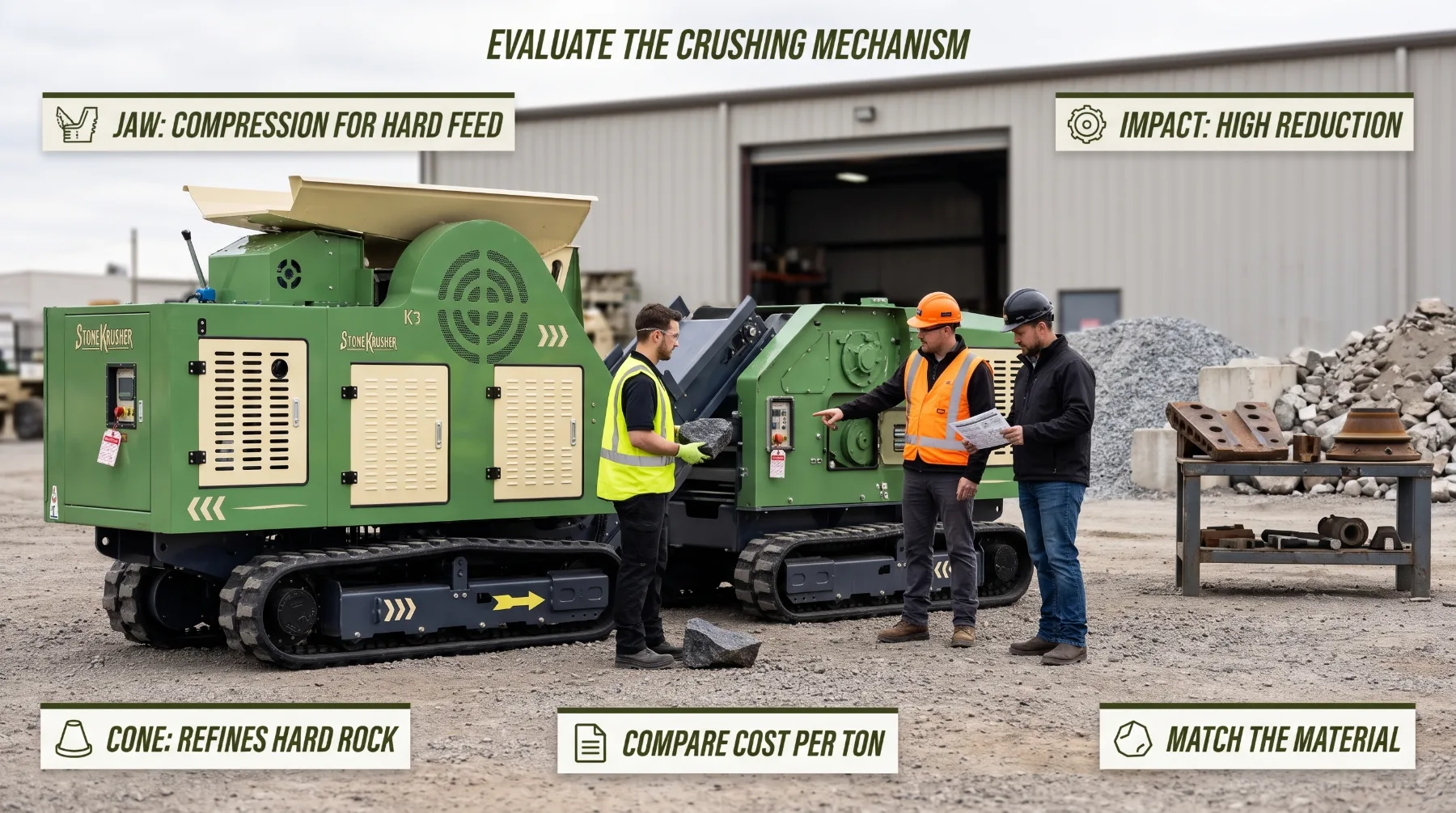
The crushing mechanism decides how force reaches the rock. It also shapes product size, particle shape, wear cost, and the range of materials the machine can handle. Choosing the right design for your material and product is one of the most important decisions in any crushing operation.
Impact crushers use high-speed impact. Horizontal shaft impactors strike rock with blow bars on a spinning rotor and throw it against aprons. They achieve higher reduction ratios, often somewhere around 10:1 to 20:1 or more, and produce a more cubical particle shape. That makes them popular for recycled concrete, asphalt, and limestone, where a single machine can often produce a finished base product. Their main limitation is wear in hard, abrasive rock. Vertical shaft impactors are typically used later in the process to shape and refine finer material.
Match the mechanism to three questions. What material will you crush? What product size and shape does your specification require? How much material do you need per hour? Then compare candidate machines using capacity tables, wear-part costs, and demonstrations with your own material. A design that excels in one application can disappoint in another.
Key takeaway: Jaw crushers handle large, hard feed with moderate reduction. Impact crushers deliver high reduction and cubical shape in softer, less abrasive material. Cone crushers refine hard rock efficiently. Choose the mechanism that fits your material and product.
Review Output Size and Production Rate
What comes out of the crusher matters as much as what goes in. Your project specification defines the size range and gradation the finished aggregate must meet. Those requirements decide the discharge setting, the number of crushing stages, and the hourly output you can realistically expect.
Start with the specification. Road base, pipe bedding, drainage stone, and backfill each require different size ranges and gradations. Confirm the requirements in your project documents and with the engineer or local agency. Recycled and crushed aggregates often require testing and approval before placement.
The discharge setting controls product size. On a jaw crusher, the closed side setting is the narrowest gap between the jaws at the bottom of the chamber. On a cone crusher, it is the gap between mantle and concave. On an impactor, product size depends on the gap between blow bars and aprons, along with rotor speed. A wider setting lets more material pass each cycle and increases tonnage, but it produces coarser aggregate. A tighter setting produces finer material but reduces throughput and increases wear and power demand.
Published capacity figures need careful reading. Manufacturers usually state capacity at a specific setting, often with medium-hard rock of a stated bulk density, under steady feed. Request capacity tables that show output at your required setting and with material similar to yours. Confirm whether figures are in short tons or metric tonnes. Recirculating oversize adds load and reduces net output, so account for it.
Verify output throughout the job. Run sieve tests after changing settings, feed material, or wear parts. As jaw plates, blow bars, and liners wear, the effective setting drifts, and the product grows coarser. Recheck and adjust at the intervals the manufacturer recommends. Always shut down the crusher and follow lockout procedures before measuring or adjusting the setting.
Key takeaway: Product size depends on the discharge setting, and tighter settings reduce throughput. Calculate the reduction ratio you need, compare capacity at your actual setting and material, and verify product with regular sieve tests.
Maintain Feeding and Crushing Components
A well-chosen crusher only performs well when material arrives steadily and its components stay in good condition. Inconsistent feeding wastes capacity and causes blockages. Worn parts reduce crushing efficiency and change product size. Disciplined feeding and maintenance protect production, product quality, and the people working around the machine.
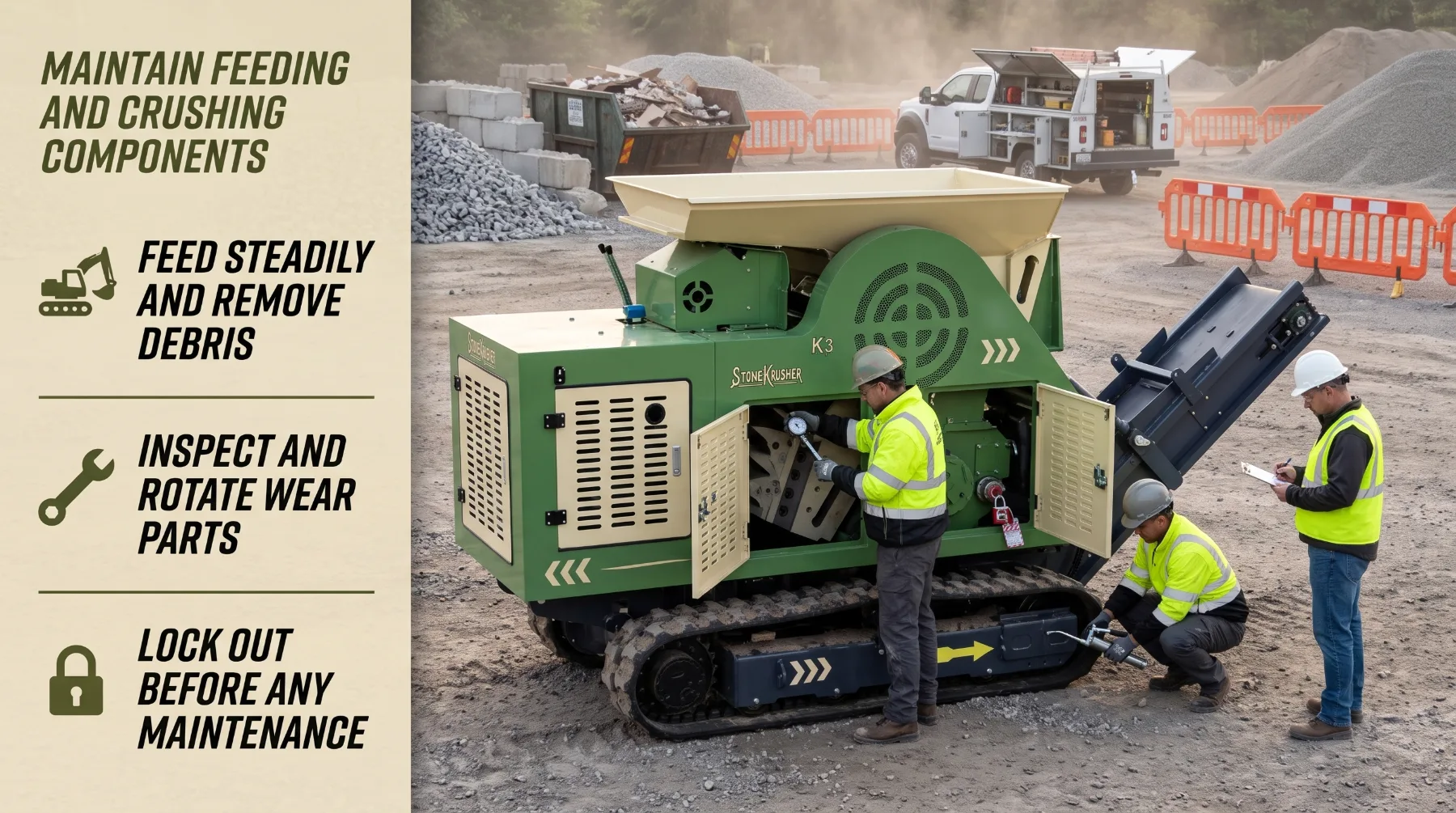
Use a consistent feeding method. The excavator or loader should deliver material at a rate that keeps the chamber working at the manufacturer's recommended level. A choke-fed jaw or cone crusher typically crushes more efficiently and produces a more consistent product than one fed in surges. Place material into the hopper with controlled bucket movements rather than dropping it from height. Match bucket size to hopper width so loads don't spill over the sides. The feeding operator needs a clear view of the hopper and reliable communication with the crusher operator.
Remove unsuitable material before feeding. Pull out wood, roots, plastic, wire, and trash. Remove visible rebar and steel from concrete, even when the plant has a magnetic separator. Set aside oversize for breaking. Stop and isolate suspect material, such as fuel-contaminated soil or building materials that may contain asbestos, and follow applicable requirements before processing it.
Inspect wear parts on a regular schedule. Check jaw plates for uneven wear, and rotate or flip them as the manufacturer allows to extend their life. Inspect cheek plates, toggle plates, and seats. On impactors, check blow bars, aprons, and liners, and turn or replace blow bars before wear reaches the rotor. On cone crushers, monitor mantle and concave wear. Track wear-part life against tonnage so you can forecast replacement and cost per ton.
Check the supporting systems as well. Inspect belts, bearings, drives, feeders, grizzly bars, and discharge conveyors. Grease bearings at the specified intervals, and watch for heat, noise, or vibration that signals developing problems. Keep belt and pulley guards in place, and test emergency stops before every shift. Make sure the discharge conveyor keeps pace with crusher output, since backed-up material quickly stops production.
Key takeaway: Feed steadily, remove unsuitable material, and inspect wear parts, bearings, belts, and guards on schedule. Always lock out and verify isolation before clearing blockages or performing maintenance.
Conclusion
Crushing force and feed size are key factors in stone crusher performance, but overall efficiency depends on several related components. Crushing force is generated through compression or impact, while engine power, chamber design, and protective systems determine how effectively that force breaks down rock. Feed material must remain within the manufacturer's maximum size to ensure proper processing. Rock hardness affects crushing force requirements, while abrasiveness influences wear and operating costs. The crushing mechanism also determines material reduction, product shape, and suitability for different applications. Discharge settings and consistent feeding further affect output size and production capacity. When evaluating a stone crusher, consider the largest and most irregular feed pieces, rock type, hardness, silica content, and required finished product sizes. Review maximum feed size, production capacity at different discharge settings, and expected wear-part life for each model. A practical demonstration using representative material can help assess actual performance. Combine suitable equipment selection with consistent feeding, scheduled maintenance, and proper lockout procedures to improve production reliability, control operating costs, and maintain a safe crushing operation.
Frequently Asked Questions
What does crushing force mean?
It is the force applied by the crusher's mechanism to break material into smaller pieces. Jaw and cone crushers apply force through compression, while impact crushers apply it through high-speed strikes. Manufacturers usually describe it indirectly through power, chamber design, and capacity figures.
Why is feed size important?
Feed size determines whether incoming material fits within the crusher's permitted operating dimensions. Oversized pieces can bridge, stall the crusher, and overload components. Keeping feed within the manufacturer's maximum size supports steady production and safer operation.
Does harder rock affect crusher production?
Yes. Hard rock requires more crushing energy and usually stays in the chamber longer, which reduces hourly output at the same setting. Abrasive rock also wears jaw plates, blow bars, and liners faster, raising operating cost per ton.
How can contractors improve crusher performance?
Use suitable feed material, remove oversize and fines, and maintain consistent feeding. Select a crushing mechanism and setting that matches the rock and required product. Service wear components on schedule, and verify output with regular sieve tests.