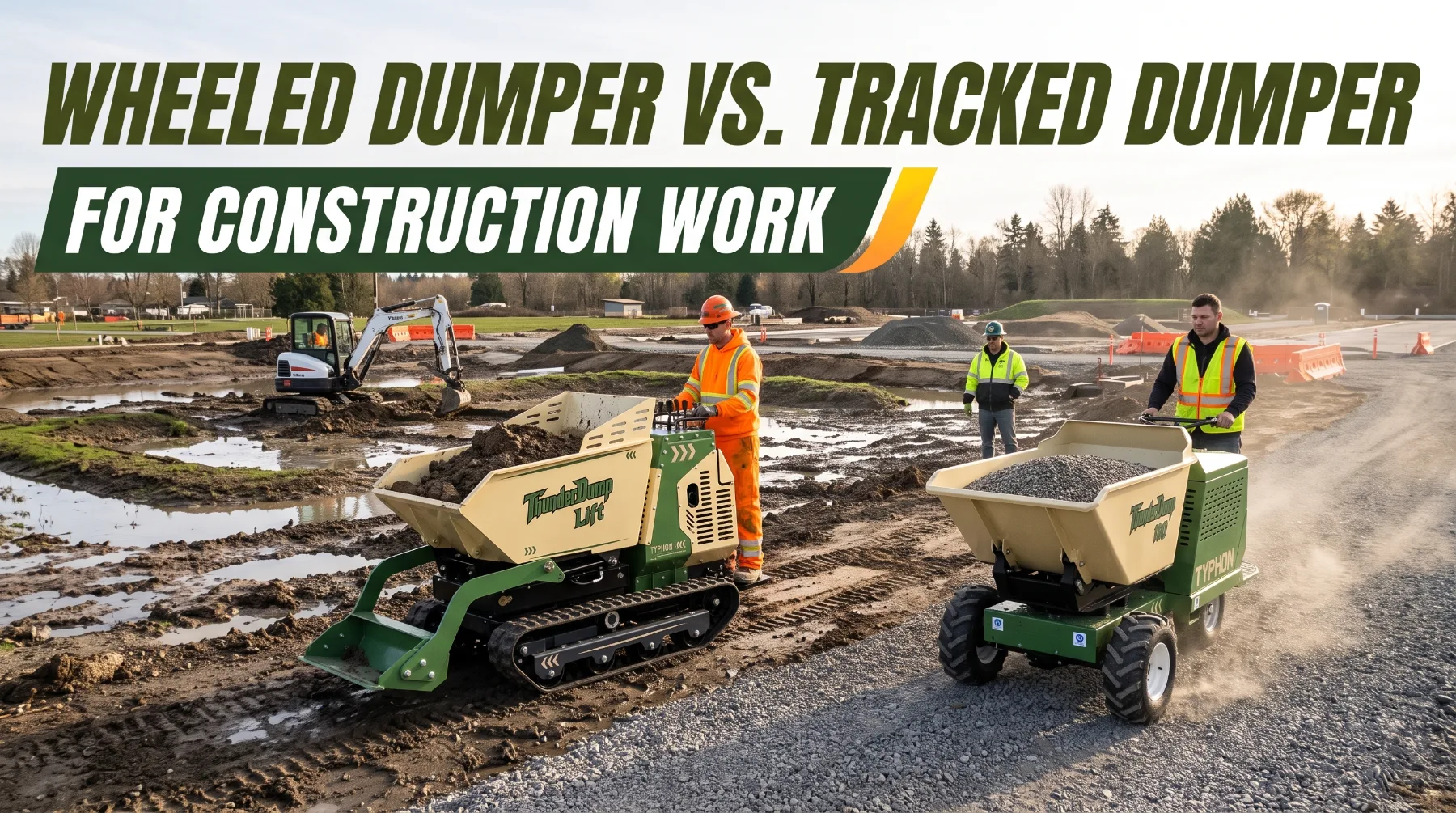
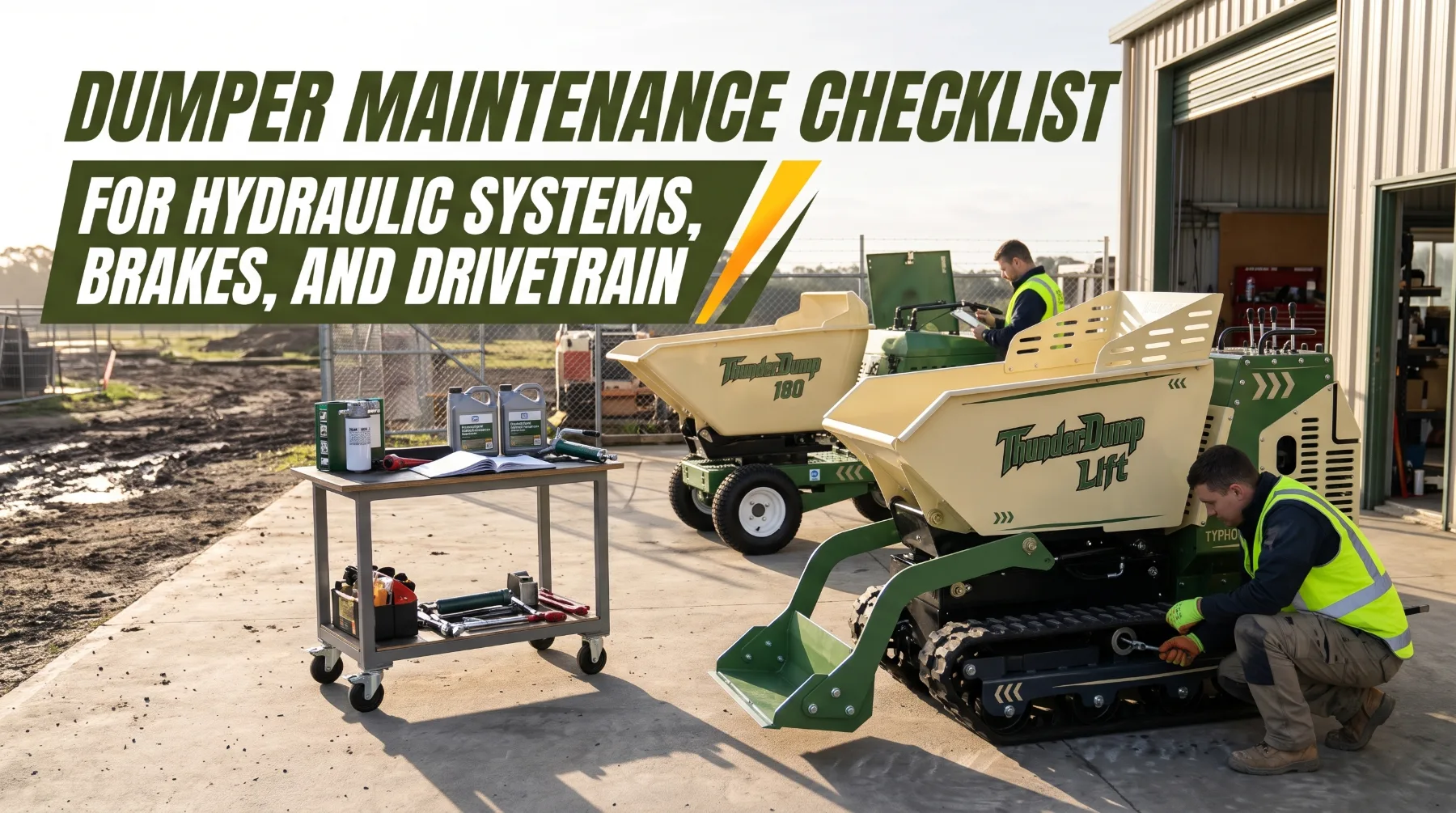
A compact dumper finishes a long week hauling wet clay up a temporary ramp on a residential build. On Monday morning, the operator loads the bed, starts the climb, and notices the bed lift is slow and the machine pulls to one side. Halfway down the return slope, the brake pedal feels softer than usual. None of these problems appeared overnight. A weeping hose fitting, a clogged hydraulic filter, a loose drive chain, and a worn brake component had been building for days. A routine inspection would have caught each one.
Compact dumpers work in some of the harshest conditions on any jobsite. Mud, dust, heavy loads, steep ramps, and uneven surfaces all speed up wear on the components that lift, stop, and drive the machine. Regular maintenance of the hydraulic system, brakes, and drivetrain keeps material moving, reduces unexpected downtime, and protects operators and ground crews. This checklist explains what to inspect, what warning signs to watch for, and how to build records that keep every dumper in your fleet safe and dependable.
Inspect Hydraulic Hoses and Cylinders
The hydraulic system raises and lowers the bed, powers high-tip and swivel functions where fitted, and on many tracked dumpers drives the tracks through hydrostatic motors. Hoses, fittings, and cylinders carry oil at high pressure through every one of those functions. They also flex with each lift, vibrate across rough ground, and sit exposed to mud, stones, and debris. That combination makes them some of the first components to show wear.
Start every inspection with the machine parked on firm, level ground, the bed fully lowered, the engine off, and the key removed. If any inspection requires the bed to be raised, engage the bed support or safety prop according to the operator's manual. Never work beneath a raised bed that is held up only by hydraulic pressure, since a hose failure or control movement can drop it without warning.
Walk around the machine and inspect each hydraulic hose along its full length. Look for abrasion, cracked or blistered outer covers, bulges, kinks, and exposed reinforcement wire. Pay close attention to areas where hoses rub against the frame, pass near the tracks or tires, or bend sharply when the bed lifts. Check fittings and connections for weeping oil, loose nuts, corrosion, and damaged threads. A thin film of oil and dirt around a fitting often marks the start of a leak.
Inspect the lift cylinders next. Look at the cylinder rods for scoring, pitting, rust, and bent sections, since a damaged rod can tear the seals each time it retracts. Check the rod seals for oil leaking down the rod or collecting at the cylinder gland. Inspect cylinder mounting pins, bushings, and brackets for looseness, cracks, and excessive wear. During operation, watch for a bed that lifts unevenly, moves in jerks, makes unusual noise, or drifts down when the control is in neutral. Also check the dumper's dumping height to ensure it can discharge materials into the intended truck, skip, or container without obstruction. Each of these signs points to a problem that needs attention before the next load.
Leak detection requires strict caution. Never use your hands or fingers to search for a high-pressure hydraulic leak. A pinhole leak can release fluid with enough force to penetrate skin and cause severe injury that requires immediate medical treatment. Use a piece of cardboard or wood to locate the leak, and wear gloves and eye protection. Relieve hydraulic pressure according to the operator's manual before loosening any fitting or replacing a hose.
Key takeaway: Inspect hoses, fittings, and lift cylinders with the bed lowered or properly supported, watch for leaks, abrasion, and damaged rods, and never use your hands to find a high-pressure leak.
Check Hydraulic Fluid and Filters
Hydraulic fluid does more than transmit power. It lubricates pumps, motors, and valves, carries heat away from working components, and helps seal internal clearances. When fluid runs low, becomes contaminated, or breaks down from heat, every hydraulic function suffers and component wear accelerates.
Check the hydraulic fluid level at the start of each shift as part of the pre-operation inspection. Follow the manufacturer's procedure exactly, since many machines require the bed to be fully lowered and the fluid to be at a specific temperature for an accurate reading on the sight glass or dipstick. Top up only with the fluid type and grade the manufacturer specifies. Mixing incompatible fluids can damage seals and reduce performance, and the wrong viscosity can starve components in cold weather or thin out too much in summer heat. A level that keeps dropping between checks points to a leak that needs locating and repairing.
Examine the fluid's condition each time you check the level. Clear fluid of the expected color is a good sign. Milky or cloudy fluid often indicates water contamination, which is common on machines washed with pressure hoses or parked outside in wet weather. Dark fluid or a burnt smell can signal overheating or fluid breakdown. Foamy fluid may point to air entering the system through a loose suction connection or low fluid level. Any of these findings deserves investigation before the machine returns to heavy work.
Hydraulic filters protect the system from the fine particles that wear pumps, motors, and valves. As a filter loads with contaminants, it restricts flow, and many filters include a bypass valve that sends unfiltered oil through the system once the element clogs. Replace hydraulic filters at the intervals listed in the operator's manual, including any early break-in change on a new machine. Respond promptly to filter restriction indicators or warning lights where fitted, and follow the manufacturer's severe-duty guidance for machines working in heavy dust or under continuous load.
Contamination prevention is part of every service. Wipe the fill cap and surrounding area clean before opening the reservoir. Use clean containers and funnels, and keep new fluid and filters sealed until use. Use only filters that meet the manufacturer's specifications for micron rating and flow, since a filter that fits but doesn't meet specification may not protect the system. Dispose of used fluid and filters according to local environmental regulations.
Key takeaway: Check hydraulic fluid level and condition daily using the manufacturer's procedure, use only the specified fluid and filters, replace filters on schedule, and keep dirt out during every service.
Inspect Brakes and Parking Brake
A loaded dumper can weigh several times its empty weight, and that mass builds momentum quickly on a downhill ramp. Reliable brakes are what allow the operator to control speed, stop smoothly, and hold the machine safely in place. Brake inspections deserve the same priority as any other safety check on the machine.
Braking systems vary by design, so start with the operator's manual for your exact model. Many tracked dumpers use hydrostatic drive, where easing off the travel control slows the machine, along with a spring-applied, hydraulically released parking brake that engages when the machine stops or shuts down. Wheeled site dumpers often use service brakes on the axles or driveline, operated by a pedal, along with a separate parking brake lever. Understanding how your machine's system works tells you what normal behavior should look and feel like.
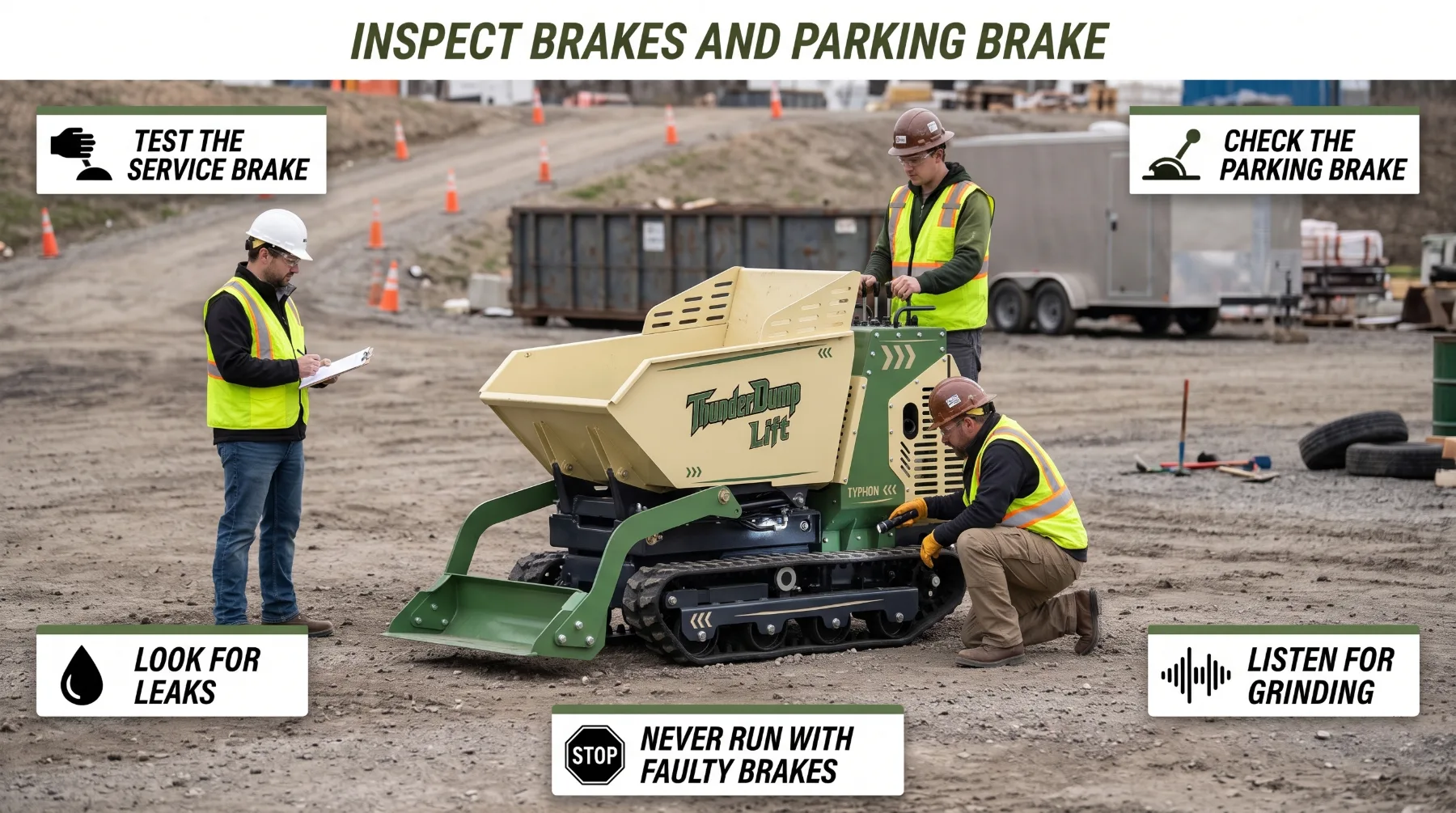
Test the service brake before every shift on firm, level ground in a clear area. The machine should slow and stop smoothly and in a straight line, without pulling to one side, grabbing, or requiring excessive pedal pressure. A pedal that feels soft, spongy, or travels farther than usual can indicate air in the system, low brake fluid, or worn components. A pedal that feels hard while the machine barely slows may point to glazed or contaminated friction surfaces. On hydrostatic machines, check that the machine slows predictably when the travel control returns to neutral.
Test the parking brake next. Confirm that it engages fully and holds the machine in place, following the test procedure in the manual. Many manufacturers describe a holding test on a suitable incline or against light travel input, so follow those instructions rather than improvising. A parking brake that slips, engages only partly, or releases unexpectedly creates a serious runaway risk when the machine is parked or loading on a slope.
Inspect visible brake components for damage and leaks. Look for brake fluid or hydraulic oil around brake lines, cylinders, and fittings. Check brake linkages and cables for wear, fraying, looseness, and correct adjustment. Watch for oil or grease contaminating brake surfaces, which sharply reduces braking performance. Listen for grinding, squealing, or scraping during operation.
Never operate a dumper with a defective braking system. If you find any brake fault, tag the machine out of service and report it immediately. Keep it parked until a qualified technician completes the repair and confirms that both the service brake and parking brake meet the manufacturer's requirements.
Key takeaway: Test the service brake and parking brake before every shift, watch for soft pedals, slipping, leaks, and unusual noise, and keep any dumper with a brake defect out of service until it is repaired.
Check Tires, Tracks, and Steering
Tires and tracks connect the dumper to the ground. Their condition determines traction on ramps, stability with a loaded bed, and how precisely the machine responds to steering inputs. Worn or poorly maintained running gear reduces control at the moments operators need it most, especially on slopes and soft ground.
On wheeled dumpers, check tire pressure with a gauge before each shift and compare it with the manufacturer's specification. Underinflated tires flex excessively, overheat, and reduce stability, while uneven pressure can make the machine lean or pull to one side under load. Inspect each tire for cuts, punctures, bulges, exposed cords, embedded debris, and uneven or excessive tread wear. Check wheel nuts for tightness according to the manual, and look for cracked or damaged rims. Uneven wear patterns can point to misalignment, incorrect pressure, or steering problems that need investigation.
On tracked dumpers, inspect the tracks for cuts, cracks, missing lugs, exposed steel cords, and damaged sections. Check track tension according to the manufacturer's procedure, usually by measuring sag at a specified point. A loose track can derail, particularly when turning or traveling across uneven ground, while an overtightened track speeds wear on rollers, idlers, sprockets, and bearings. Inspect rollers and idlers for leaks, flat spots, and seized bearings, and check the undercarriage frame for cracks and loose bolts.
Steering checks complete this section. Test steering response through its full range during the pre-shift inspection. On articulated machines, the steering should move smoothly without excessive play, binding, or unusual noise, and the articulation joint should be free of looseness and cracks. Inspect steering cylinders, linkages, pins, bushings, and tie rods for wear, leaks, and damage. On skid-steer-style tracked dumpers, confirm that both tracks respond evenly and that the machine travels straight without drifting. Any delay, stiffness, or uneven response in steering needs diagnosis before the machine carries another load.
Mud and debris deserve regular attention. Packed clay and stones add weight, reduce traction, interfere with moving parts, accelerate wear, and hide damage during inspection. Clean tracks, undercarriages, wheel wells, and steering joints at the end of each shift, and more often in heavy mud. Follow the manufacturer's guidance on pressure washing, avoiding direct high-pressure spray on seals and electrical components. Where the machine has an articulation lock, engage it according to the manual before working near the articulation joint.
Key takeaway: Check tire pressure or track tension, inspect for cuts and uneven wear, test steering response and joints, and clear packed mud and debris that hides damage and speed wear.
Keep a Maintenance Record
A maintenance checklist only works when someone tracks what was done and when. Without records, service intervals drift, filters get skipped, and recurring problems go unnoticed until they cause a breakdown. Accurate documentation turns daily inspections and scheduled service into a dependable system that keeps every dumper in working order.
Record the date and hour meter reading for every inspection and service. Note the fluids added or changed, including type, grade, and quantity. Log filter part numbers, parts replaced, repairs completed, and the name of the person who did the work. Document defects found during pre-shift inspections, along with the action taken and when the machine returned to service. Many fleets use printed service logs kept with each machine, while others use maintenance software or telematics systems that track hours and send service reminders automatically.
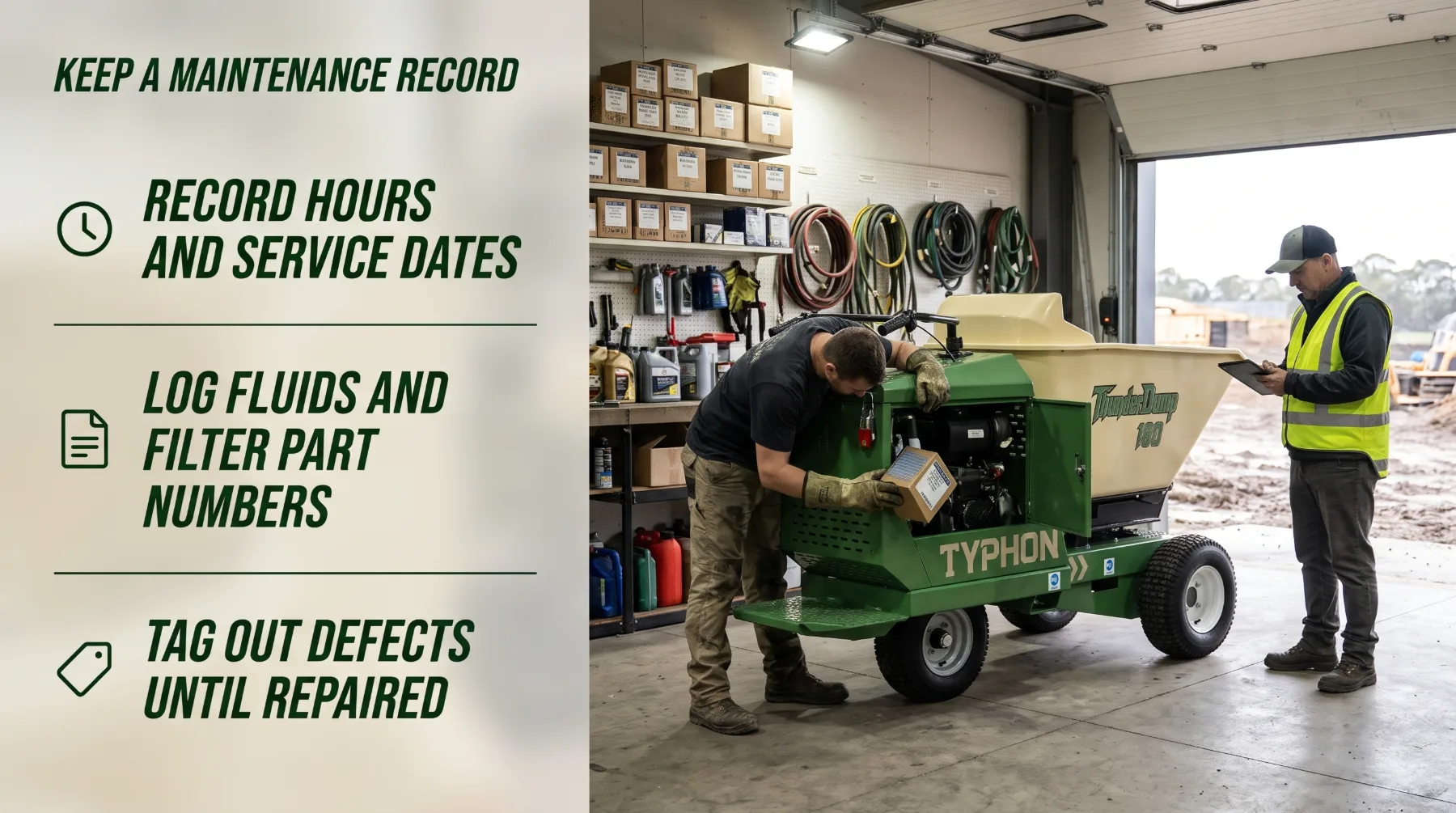
Good records prevent missed maintenance by showing exactly when the next service is due for each component. They also reveal patterns. A hydraulic hose that keeps failing in the same location may point to poor routing or rubbing. A filter that clogs faster than expected can indicate a contamination source. Brakes that need frequent adjustment may signal a deeper problem. Those patterns help maintenance teams correct root causes rather than repeating the same repair.
Records protect your investment as well. A complete service history supports warranty claims, demonstrates that maintenance followed the manufacturer's schedule, and strengthens resale value. It also supports your safety program by showing that defects were reported and repaired promptly.
Address defects promptly and use approved parts and service procedures. Keep any machine with a safety-critical defect, such as a brake fault, steering problem, or major hydraulic leak, tagged out of service until a qualified technician completes the repair. Keep a small stock of the correct filters, fluids, and common wear parts for each machine, so scheduled service happens on time instead of waiting for parts to arrive.
Key takeaway: Record hours, dates, fluids, filter part numbers, defects, and repairs for every service, use the records to spot recurring problems, and keep defective machines out of service until they are repaired.
Conclusion
Compact dumpers carry heavy loads across mud, gravel, ramps, and confined routes, making regular maintenance essential for safe and reliable operation. Inspect hydraulic hoses and cylinders for leaks or damage, use the correct fluids and replace filters on schedule to protect pumps and motors, and test brakes regularly to confirm the machine can stop and hold on slopes. Drivetrain inspections and proper lubrication help prevent costly failures, while well-maintained tires, tracks, and steering support stability and control. A consistent maintenance program should include model-specific pre-shift checklists and service records covering operating hours, fluids, filters, inspections, and repairs. Train operators to complete checks and report defects promptly. These habits help reduce downtime, protect crews, and keep material moving efficiently across every jobsite.
Frequently Asked Questions
How often should a dumper's hydraulic system be inspected?
Inspect hoses, fittings, cylinders, and fluid level before every shift as part of the pre-operation check. Follow the manufacturer's schedule for detailed servicing, hydraulic filter replacement, and fluid changes, and shorten intervals where severe-duty guidance applies to dusty or demanding conditions.
Why are brake inspections important?
Reliable brakes are essential for controlling a loaded dumper, particularly on slopes, ramps, and uneven ground. Testing the service brake and parking brake before each shift catches defects early. A dumper with any brake fault should stay out of service until a qualified technician repairs it.
What drivetrain problems should operators report?
Report unusual noise such as grinding, whining, or clunking, along with abnormal vibration, oil leaks, slipping, hesitation, loss of pulling power, or a machine that pulls to one side. Early reporting allows minor issues to be repaired before they lead to major failures.
Should maintenance records be kept?
Yes. Records track service intervals, operating hours, fluids, filter part numbers, repairs, and recurring issues. They prevent missed maintenance, help identify root causes of repeat failures, support warranty claims, and strengthen resale value.
SkidSteers.online Featured Equipment
Looking for top-performing heavy equipment, authentic attachments, and dependable jobsite power? Explore verified models backed by manufacturer warranty and nationwide delivery.
View Specifications & Pricing →